


Cecil Libraries Package
This is the OFFICIAL Cecil Libraries Organization Package for the Cecil Libraries. Treat this package as a Dependency Package. The dlls will be added into both Patchers and Plugins folders of your Install.Cecil Libraries Package
This package exists for the purpose of providing the Cecil Libraries Libraries as a Package to be utilized by mods on Thunderstore. Namely mods by Stoat Games.
The following is a outlined list of all Libraries included in this package, their documentation, changelogs, and licensing. More up to date documentation will be found here: https://stoatgames.icu/subsidiaries/cecil-libraries-organization/
The official version of this package is: https://thunderstore.io/c/inscryption/p/Cecil_Libraries_Organization/Cecil_Libraries_Package
The /Cecil_Libraries_Organization/Cecil_Libraries_Package in that URL refers directly to the officially uploaded package, if you find a listed package that has any of the contents of this package elsewhere on the site, report it, than have us upload our package to the given community if it is not already there.
If you find any innaccuricies in this packages documentation let us know via [email protected] or Contact&[email protected], and we'll update it. We are already aware of several bugs with deprecated functionality of Cecil.ANSI_Utils 2.0.0 that will be fixed with 3.0.0. Aim to use the non-deprecated ends of this library instead.
Also it is reccomended to use in corrolation with Stoat Games: ANSI Mod which will be posted shortly after this package goes live. This mod provided by Stoat Games enables Virtual Terminal Processing on Windows so that Cecil.ANSI_Utils will function correctly in BepInEx context. (It also enables UTF-8 Text Encoding in the Terminal after it starts in the Patchers phase.)
This package is Licensed under CLL-1.0.0 and SML-1.0.0
Cecil ANSI Utilities (v2.0.0)
Copyright 2025 Cecil Libraries Organization and the Founder(s) Chaosyr
- NUGET Package Link: https://www.nuget.org/packages/Cecil.ANSI_Utils/2.0.0
- Full Version Changelog: https://github.com/Cecil-Libraries/Cecil-ANSI-Utils/compare/v1.2.0...v2.0.0
- Support Discord: https://discord.gg/8yDjSXzvgu
FAQ's/Project Intro
What is Cecil Libraries?
Cecil Libraries are a group of libraries in which extend functionality to many API and provide utilities as a Pseudo-API for several necessity's.
Who is Cecil?
Both a Member of the Vessel Chaosyr, and the Mascot of our Libraries. Mascot wise she is as originally described by Chaosyr "10ft tall, raven, succubus, whom is Bi, Poly, and a Femboy". That's as far as we are with her at the moment, if more details arrive it will be on the Organizations main page, figured we'd fill in for the case anyone's wondering what the logo stems from.
What is this Library for?
This library is primarily for enabling the ability to utilize ANSI Color Codes on a much greater scope within the Console associated with most Console Apps. It also contains some functions for converting HSV/HSL, Gray and Hex Code into RGB. Note HSL/HSV rounding is slightly off somewhere by a point or two in present so it might not be perfect.
Library Documentation (Ansi Utils)
This will probably be easier to navigate through in the GitHub's Wiki, however this will just be as in depth as the Wiki will be, so everything you need will be within this very file, the Code is also fully commented if you wish to jump straight into coding. If any explanations are weaker than other let us know so we can fix it up!
The Color List's
These list's stem I believe all the way back to Chaosyr's AP Computer Science Principles Project when they were making a Book Displayer Console App of sorts.
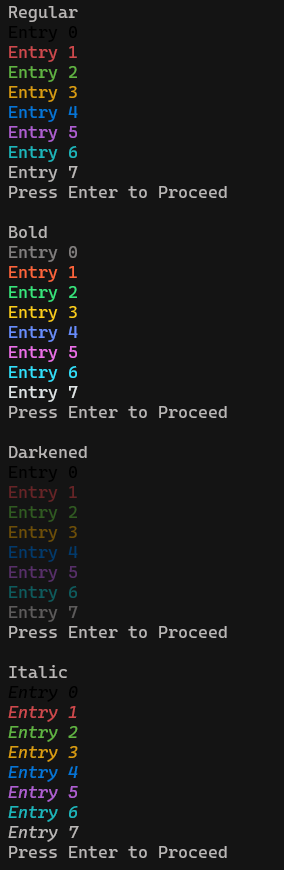
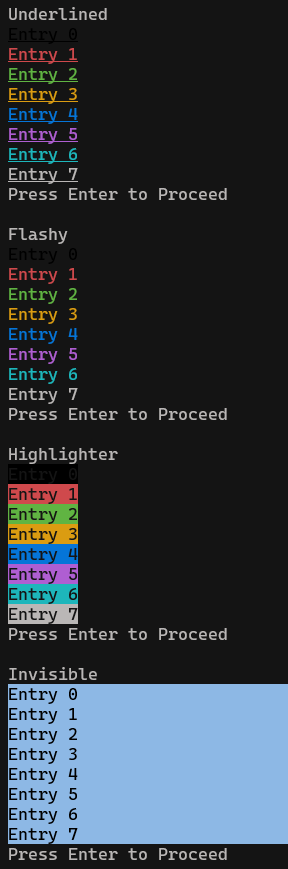
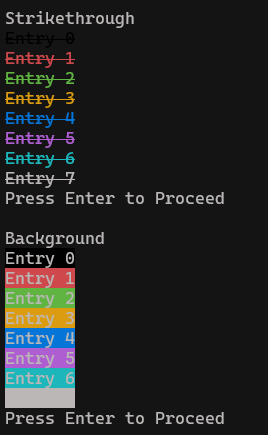
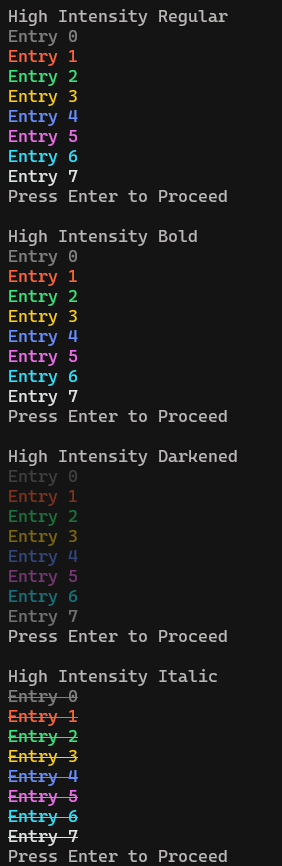
First off the Most Useful tool for seeing how these work would be calling Displayer.DisplayListBased(), this will iterate through every Color List we have in this project in a really nice to look and understand at way. If you're too lazy to call it here's a few Screenshots.
Regular
Taken In Microsoft's Command Prompt
Taken In Microsoft's Command Prompt
Taken In Microsoft's Command Prompt
High Intensity
Taken In Microsoft's Command Prompt
Taken In Microsoft's Command Prompt
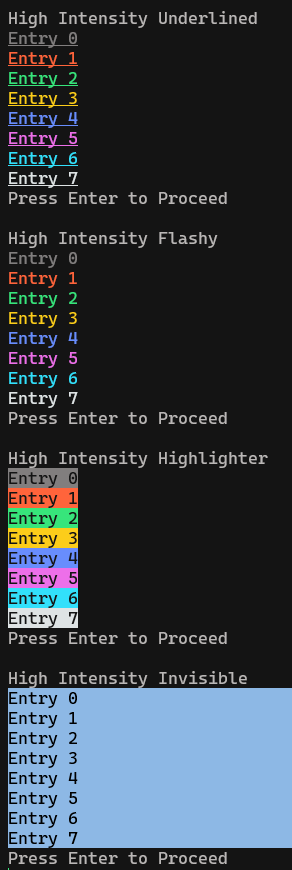
Taken In Microsoft's Command Prompt
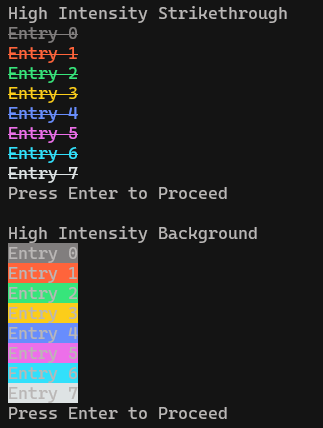
Calls
Calling the Lists are pretty straightforward. But essentially call ANSICodeLists than apply a .WhateverListThisIs to the end of it, and to choose an Entry append a [X] to the end of it, the X being the Entry Number shown in the above screenshots. For example ANSICodeLists.ColorList[4] would be Blue on the Regular list, apologies for any weird namings, these Lists are Old, the names will likely be standardized in the future, though it's highly recommended to use the Color Objects instead as it's much easier to work with.
GetColorFromType
These Functions Stem from a Mod Chaosyr made to enable ANSI in the BepInEx Console. They are also marked as Obsolete now as the Color Objects are much better to work with. So how do I use them? Well first you will need the context of the below tables for Inputs, there's a reminder of them in the functions Code Comments. Also for reference this utilizes the List's within ANSICodeLists to simplify the process [still overly complex though].
Type List;
| Input | Description |
|---|---|
| Regular | The regular old fashioned color display system that just changes the color |
| Bold | The Bolded Version of the old fashioned color display, it changes both the color, and makes the text bolded or brighter. |
| Darkened | The Darkened Version of the old fashioned color display, it changes both the color, and makes the text dulled or darker. |
| Italic | The Italic version of the old fashioned color display, it changes both the color, and makes the text slanted. |
| Underlined | The Underlined version of the old fashioned color display, it changes both the color, and makes the text appear with a line beneath it. |
| Flashy | The Flashy version of the old fashioned color display, it changes both the color and makes the text blink on and off slowly. |
| Highlighter | The Highlighter version of the old fashioned color list, it changes both the color, and makes the foreground [text] and background invert there colors giving off the effect that it is being highlighted. |
| Invisible | The Invisible version of the old fashioned color list, it changes both the color, and and makes it so that when the text is highlighted with the cursor it will show the text contents. |
| Strikethrough | The Strikethrough version of the old fashioned color list, it changes both the color, and puts a line e.g. a strike through the text being displayed. |
| Background | This instead of changing the foreground [text] changes the background to the color. |
| HighIntensityRegular | The regular high intensity version of the color display system that just changes the color |
| HighIntensityBold | The Bolded Version of the high intensity version of the color display, it changes both the color, and makes the text bolded or brighter. |
| HighIntensityDarkened | The Darkened Version of the high intensity version of the color display, it changes both the color, and makes the text dulled or darker. |
| HighIntensityItalic | The Italic version of the high intensity version of the color display, it changes both the color, and makes the text slanted. |
| HighIntensityUnderlined | The Underlined version of the high intensity version of the color display, it changes both the color, and makes the text appear with a line beneath it. |
| HighIntensityFlashy | The Flashy version of the high intensity version of the color display, it changes both the color and makes the text blink on and off slowly. |
| HighIntensityHighlighter | The Highlighter version of the high intensity version of the color list, it changes both the color, and makes the foreground [text] and background invert there colors giving off the effect that it is being highlighted. |
| HighIntensityInvisible | The Invisible version of the high intensity version of the color list, it changes both the color, and and makes it so that when the text is highlighted with the cursor it will show the text contents. |
| HighIntensityStrikethrough | The Strikethrough version of the high intensity version of the color list, it changes both the color, and puts a line e.g. a strike through the text being displayed. |
| HighIntensityBackground | This instead of changing the foreground [text] changes the background to the high intensity version of the color. |
Colors
| Input | Input Number |
|---|---|
| Black | 0 |
| Red | 1 |
| Green | 2 |
| Yellow | 3 |
| Blue | 4 |
| Magenta | 5 |
| Cyan | 6 |
| White | 7 |
Calls
Now how would you call this functionality? Well as follows; GetColorFromType.GetColorFromString(Color, Type) or GetColorFromInt.GetColorFromInt(Color, Type). Again these are marked as Obsolete, and it is recommended that you instead use the Color Objects this library provides.
Reset Codes
These are pretty straight forward, there are 3 hard coded constants provided for Resets, one for Everything, one for Foreground affects and one for Background affects e.g. Colors, the resets for the Text Types are in the Objects or bundled in the Everything Reset.
Calls
ANSICodeLists.ResetColorthis resets all effects done to the foreground, background, and all Text Types to default.ANSICodeLists.ResetForegroundthis resets all effects done to the foreground.ANSICodeLists.ResetBackgroundthis resets all effects done to the background.
ColorBase Object (2.0.0+)
This is the base object shared by Color, Color256 and ColorRGB, it contains shared variables and functions.
Getters and Setters
| Entry | What it is and or is used to do |
|---|---|
| BaseString | This is the base of the ANSI Escape Code for Colors. |
| Type | The effect being applied to the Text Processor, this is in the form of a Integer |
| BasicShade | This is the shade after the constructors run through their logic, the first 1-2 digits are whether its background or foreground, and the last digit is the shade. |
| Reset | A bool determining whether the Object classifies as a Reset or not, |
| Background | A bool determining whether the Object classifies as a Background or not. |
| Extra | A variable for defining any Child Specific components in the ANSI Code String that .Format() creates. |
GetTypeString()
This function pretty much just says oh, we have this Type, and we had a String switch already to make it an integer, lets reverse the integers last digit back to the original string and send that back. This has little to no use case off the top of my head and is mainly utilized for the Displayer associated with the Color object.
Format()
This function is vital to displaying the Code onto the screen so it takes affect. What this does well, in laymen's terms it formats the Variables in the Object into a Proper ANSI Escape Code for Colors. Though it's a bit more complex, and I'd recommend checking out the code to see the full of what it does! Same for the Constructors if you have not!
ToggleBackground()
This function just switches the State of the Foreground to Background and vice versa for the Object given.
Color Object
This is a more refined system for doing basic stuff with ANSI Color Codes, it was made for the purpose of being in this Project. Beware this will be a long section because it's a powerful Object. So first off let's go over the getters and setters of the Object.
Getters and Setters
| Entry | What it is and or is used to do |
|---|---|
| BaseString | This is the base of the ANSI Escape Code for Colors. |
| Type | The effect being applied to the Text Processor, this is in the form of a Integer |
| BasicShade | This is the shade after the constructors run through their logic, the first 1-2 digits are whether its background or foreground, and the last digit is the shade. |
| Reset | A bool determining whether the Object classifies as a Reset or not, |
| Background | A bool determining whether the Object classifies as a Background or not. |
| HighIntensity | A bool determining whether the Object classifies as being High Intensity or not. |
| BaseColor | The Color as it was passed into the Constructor in Integer form before BG/HI was applied to the Int for the Escape Code |
Now let's move onto the Constructors, these are pretty much the same but there is a few differences.
Construction
Since the Types and Colors can be both String and Int we need to define both luckily we already defined it in the GetColorFromType so let's take that and modify it to match the new setup.
Type List;
| Input | Description | Integer Input |
|---|---|---|
| Regular | The regular old fashioned color display system that just changes the color | 0 |
| Bold | The Bolded Version of the old fashioned color display, it changes both the color, and makes the text bolded or brighter. | 1 |
| Dulled | The Darkened Version of the old fashioned color display, it changes both the color, and makes the text dulled or darker. | 2 |
| Italic | The Italic version of the old fashioned color display, it changes both the color, and makes the text slanted. | 3 |
| Underlined | The Underlined version of the old fashioned color display, it changes both the color, and makes the text appear with a line beneath it. | 4 |
| Blink | The Flashy version of the old fashioned color display, it changes both the color and makes the text blink on and off slowly. | 5 |
| Rapid | The Flashy version of the old fashioned color display, it changes both the color and makes the text blink on and off rapidly. | 6 |
| Highlight | The Highlighter version of the old fashioned color list, it changes both the color, and makes the foreground [text] and background invert there colors giving off the effect that it is being highlighted. | 7 |
| Underlight | The Invisible version of the old fashioned color list, it changes both the color, and and makes it so that when the text is highlighted with the cursor it will show the text contents. | 8 |
| Strikethrough | The Strikethrough version of the old fashioned color list, it changes both the color, and puts a line e.g. a strike through the text being displayed. | 9 |
| Doubleline | The Doubleline version of the old fashioned color list, it changes both the color, and puts a line under the text, with another line under that line | 21 |
| Overline | The Overline version of the old fashioned color list, it changes both the color, and puts a line over the text. | 53 |
| Framed | The Framed version of the old fashioned color list, it changes both the color, and puts a box around the text. | 51 |
| Encircled | The Encircled version of the old fashioned color list, it changes both the color, and puts a circle around the text. | 52 |
Doubleline, Overline, Framed, and Encircled are part of version 1.2.0+ of the library.
Colors
| Input | Input Number |
|---|---|
| Black | 0 |
| Red | 1 |
| Green | 2 |
| Yellow | 3 |
| Blue | 4 |
| Magenta | 5 |
| Cyan | 6 |
| White | 7 |
Okay now back to the Constructor, there are 3 optional bool's all defaulting to false, here's how they work;
- Reset - Marks the Object as a Reset Object and makes the appropriate reset object.
- Background - Marks the Object as a Background Object and makes the BasicShade take the form of a Background in the code,
- HighIntensity - Marks the Object as a HighIntensity Object and makes the BasicShade take the form of a HighIntensity shade in the code,
Some takeaways about these 3 items;
- Reset is done by checking the Type, so if you want to reset the color and a type at the same time you'll need at least a Color Object with just the color change, and a Color Object with the Type Change than call
.GetReset().Format()on both to do the same effect, we may add a Function that gets a "Full" reset of sorts in the future. - An Object can both be a Background and HighIntensity.
- When turning these markings on you need to do something like
reset: truein the constructor, this way the order isn't relevant, and you don't need to dofalseon all properties irrelevant, as they all default false.
Now let's get into the Object's Functions.
GetReset()
This function pretty much just says, hey this is our current object, lets just pass back the same object EXCEPT, reset is marked as True. This works because you need to do .Format() in order to get the code anyhow, and both the constructor and the .Format() handle reset Objects already.
GetTypeString()
This function pretty much just says oh, we have this Type, and we had a String switch already to make it an integer, lets reverse the integers last digit back to the original string and send that back. This has little to no use case off the top of my head and is mainly utilized for the Displayer associated with the Color object.
Format()
This function is vital to displaying the Code onto the screen so it takes affect. What this does well, in laymen's terms it formats the Variables in the Object into a Proper ANSI Escape Code for Colors. Though it's a bit more complex, and I'd recommend checking out the code to see the full of what it does! Same for the Constructors if you have not!
GetTypeVariant(string/int type) (1.1.0+)
This function essentially says, so this is our current object, lets take that and give it the type your after.
GetColorVariant(string/int color) (1.1.0+)
This function does similar to GetTypeVariant() however, it affects the set color instead.
ToggleBackground() (1.1.0+)
This function just switches the State of the Foreground to Background and vice versa for the Object given.
ToggleHighIntensity() (1.1.0+)
This function just switches the State of the HighIntensity to LowIntensity and vice versa for the Object given.
Displayer
There is a Displayer associated with this Object to show all possibilities, you can call it via Displayer.DisplayColor(), this one I'd run yourself sense almost every console displays it differently for some reason The first screenshot is taken with JetBrains Rider, and the latter is taken with Microsoft's built-in Windows 11 Terminal. I show both rather than just Rider because Microsoft's Terminal actually handles the Underlight correctly (claps), however at the same time for some reason when Dulled Italic and Underlined are next to each other it decides to underline all 3 of them?!?! In fact double underline applied for Dulled and Italic, each mode is reset after usage for record so that shouldn't even be possible. But that's asides the point XD
Taken in JetBrains Rider
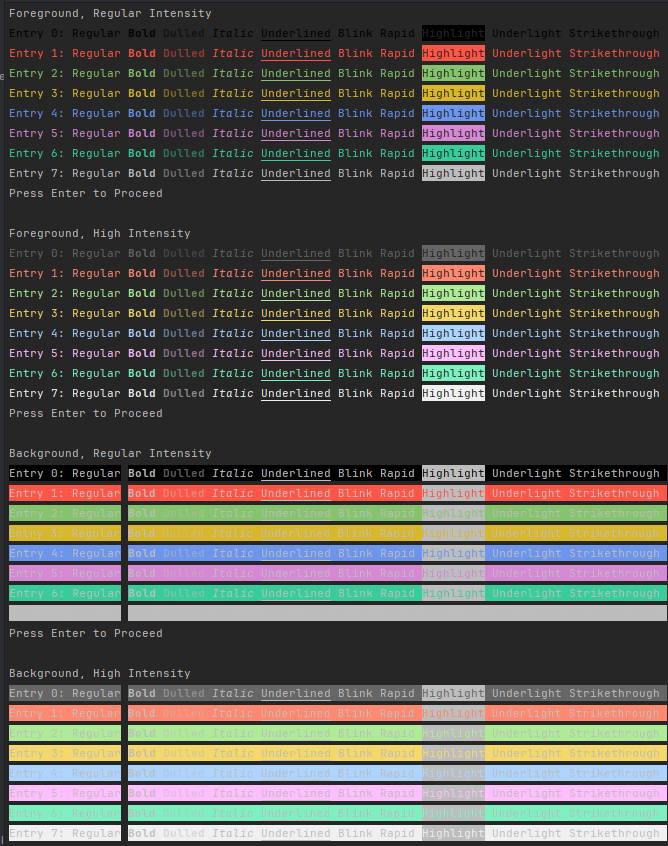
Taken In Microsoft's Command Prompt
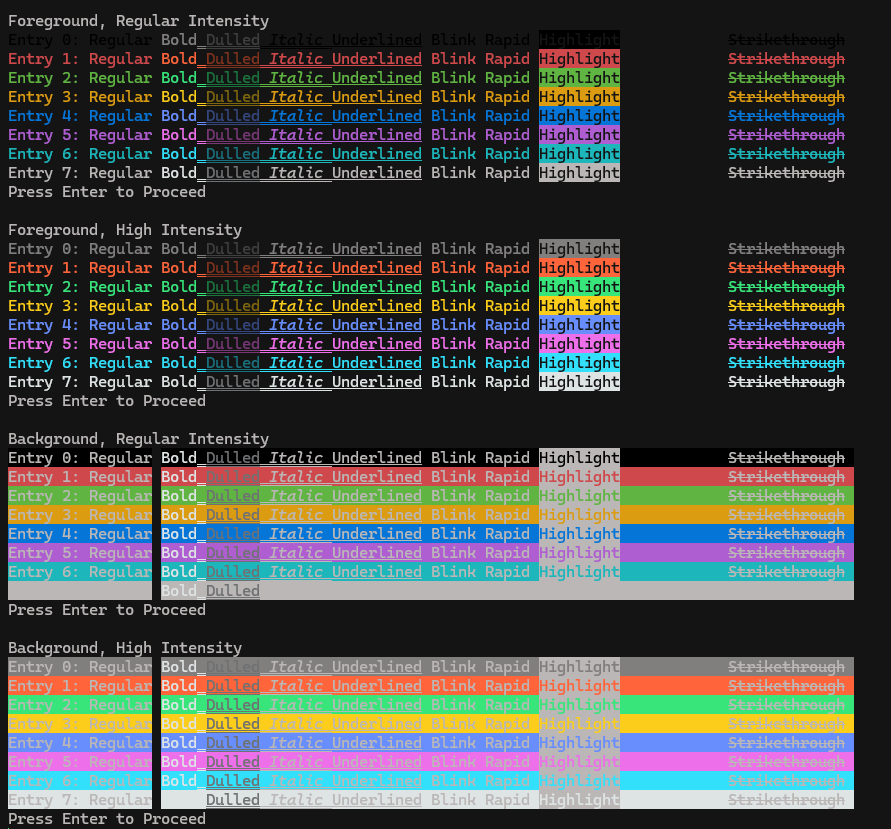
Calls
So you may be wondering, well how do I utilize this Object within my own code? Here's an Example taken from the Tester used in Development of how you can use it, in fact two examples.
Example 1
public static void Test()
{
    Console.WriteLine("Test 2");

    Color highlightRed = new Color("Highlight", "Red");
    Color delightRed = new Color("Highlight", "Red", reset:true);
    Color red = new Color("Regular", "Red");
    Color dered = new Color("Regular", "Red", reset:true);

    Console.WriteLine($"{red.Format()}This is a {highlightRed.Format()}ANSI{delightRed.Format()} Test{dered.Format()}, test complete");
    Console.ReadLine();
}
Taken In Microsoft's Command Prompt

So what is this doing? Well it's pretty straightforward, we are creating in this case 4 Color Objects [GetReset() did not exist yet], after creating these objects which are essentially Set Red with Highlight, Unset Highlight, Set Red, Unset Red, we test them by printing a line note how each Object in the printed line is followed by .Format() this is a required component so the ANSI Code actually prints and causes the format to change, note Legacy consoles will display the exact code instead, you can change this by enabling VirtualMachineProcessing at least on Windows.
Example 2
public static void Test()
{
    Console.WriteLine("Test 5");

    Color highlightRedBGHI = new Color("Highlight", "Red", background:true, highIntensity:true);
    Color delightRedBGHI = new Color("Highlight", "Red", reset:true, background:true, highIntensity:true);
    Color redBGHI = new Color("Regular", "Red", background:true, highIntensity:true);
    Color deredBGHI = new Color("Regular", "Red", reset:true, background:true, highIntensity:true);

    Console.WriteLine($"{redBGHI.Format()}This is a {highlightRedBGHI.Format()}ANSI{delightRedBGHI.Format()} Test{deredBGHI.Format()}, test complete");
    Console.ReadLine();
}
Taken In Microsoft's Command Prompt

You may have noticed this is nearly identical to Test 2, and that's intentional, in this case we are enabling highIntensity and the background booleans so we change the background color versus the foreground one, and so that the colors appear brighter. Again notice that .Format() is required to display the color change properly.
Example 3
Lastly let me show you the Displayer Code so you can see how to utilize .Reset()
Console.WriteLine("Foreground, Regular Intensity");

for (int i = 0; i < 8; i++)
{
    Color baseColor = new Color(0, i);
    string LinetoPrint = $"{baseColor.Format()}Entry {i}: ";

    for (int type = 0; type < 10; type++)
    {
        Color typedColor = new Color(type, i);
        LinetoPrint += $"{typedColor.Format()}{typedColor.GetTypeString()}{typedColor.GetReset().Format()} ";
    }

    Console.WriteLine(LinetoPrint + $"{baseColor.GetReset().Format()}");

    if (i % 15 == 0 && i != 0)
    {
        Console.WriteLine("Press Enter to Proceed");
        Console.ReadLine();
    }
}

Console.WriteLine("Press Enter to Proceed");
Console.ReadLine();
You already saw what this outputs in the Displayer section, so allow me to explain how the code works. In this case we start by looping through the 8 shades available in the Object. Within this Loop, we create a Color Object of the current iterated color, and set up the start of the printed line, being the $"{baseColor.Format()}Entry {i}: " what this does is set the color to the current iterated color, and set up the Entry with its associated number. What's next? We loop through all possible types for the current color. In this nested loop we do the following, create a typedColor e.g. a color which is set to the iterators color, and to the current type in iteration. After we do that we append the printed line with the following; $"{typedColor.Format()}{typedColor.GetTypeString()}{typedColor.GetReset().Format()}" it looks really complex but, it's not. What this is doing in a nutshell is this; Setting the Color and the current Mode to print, since we don't know the Types Name we call GetTypeString() to fetch it, and then after this we Reset the mode back to just the iterators color via .GetReset().Format(), this is essentially formatting the code of the outputted reset from GetReset(). Think of it as this; Set Mode, Say Something, Unset Mode. Once we clear the type loop, we print the line and append $"{baseColor.GetReset().Format()}" this says Reset Color, this way we ensure that the next line has the correct colors applied. Afterward we do a check by mod of 15 [not applicable here but applicable in 256] to pause the loop so that the person running the display can actually see the options they have. After we iterated through all colors, then we send the standard press enter to proceed.
Color256
This is a more refined system for doing basic stuff with ANSI Color Codes, it was made for the purpose of being in this Project. Beware this will be a long section because it's a powerful Object. So first off let's go over the getters and setters of the Object.
Getters and Setters
| Entry | What it is and or is used to do |
|---|---|
| BaseString | This is the base of the ANSI Escape Code for Colors. |
| Type | The effect being applied to the Text Processor, this is in the form of a Integer |
| BasicShade | This is the shade after the constructors run through their logic, the first 1-2 digits are whether its background or foreground, and the last digit is the shade. |
| Shade256 | This is the Shade of the Color256 being sent in. |
| Reset | A bool determining whether the Object classifies as a Reset or not, |
| Background | A bool determining whether the Object classifies as a Background or not. |
Now let's move onto the Constructors, these are pretty much the same but there's a few differences.
Construction
Since the Types can be both String and Int we need to define both luckily we already defined it in the GetColorFromType so let's take that and modify it to match the new setup.
Type List;
| Input | Description | Integer Input |
|---|---|---|
| Regular | The regular old fashioned color display system that just changes the color | 0 |
| Bold | The Bolded Version of the old fashioned color display, it changes both the color, and makes the text bolded or brighter. | 1 |
| Dulled | The Darkened Version of the old fashioned color display, it changes both the color, and makes the text dulled or darker. | 2 |
| Italic | The Italic version of the old fashioned color display, it changes both the color, and makes the text slanted. | 3 |
| Underlined | The Underlined version of the old fashioned color display, it changes both the color, and makes the text appear with a line beneath it. | 4 |
| Blink | The Flashy version of the old fashioned color display, it changes both the color and makes the text blink on and off slowly. | 5 |
| Rapid | The Flashy version of the old fashioned color display, it changes both the color and makes the text blink on and off rapidly. | 6 |
| Highlight | The Highlighter version of the old fashioned color list, it changes both the color, and makes the foreground [text] and background invert there colors giving off the effect that it is being highlighted. | 7 |
| Underlight | The Invisible version of the old fashioned color list, it changes both the color, and and makes it so that when the text is highlighted with the cursor it will show the text contents. | 8 |
| Strikethrough | The Strikethrough version of the old fashioned color list, it changes both the color, and puts a line e.g. a strike through the text being displayed. | 9 |
| Doubleline | The Doubleline version of the old fashioned color list, it changes both the color, and puts a line under the text, with another line under that line | 21 |
| Overline | The Overline version of the old fashioned color list, it changes both the color, and puts a line over the text. | 53 |
| Framed | The Framed version of the old fashioned color list, it changes both the color, and puts a box around the text. | 51 |
| Encircled | The Encircled version of the old fashioned color list, it changes both the color, and puts a circle around the text. | 52 |
Doubleline, Overline, Framed, and Encircled are part of version 1.2.0+ of the library.
Okay now back to the Constructor, the shade parameter is a value of 0-255, there are also 2 optional bool's all defaulting to false, here's how they work;
- Reset - Marks the Object as a Reset Object and makes the appropriate reset object.
- Background - Marks the Object as a Background Object and makes the BasicShade take the form of a Background in the code,
Some takeaways about these 2 items;
- Reset is done by checking the Type, so if you want to reset the color and a type at the same time you'll need at least a Color256 Object with just the color change, and a Color256 Object with the Type Change than call
.GetReset().Format()on both to do the same effect, we may add a Function that gets a "Full" reset of sorts in the future. - When turning these markings on you need to do something like
reset: truein the constructor, this way the order isn't relevant, and you don't need to dofalseon all properties irrelevant, as they all default false.
Now let's get into the Object's Functions.
GetReset()
This function pretty much just says, hey this is our current object, lets just pass back the same object EXCEPT, reset is marked as True. This works because you need to do .Format() in order to get the code anyhow, and both the constructor and the .Format() handle reset Objects already.
GetTypeString()
This function pretty much just says oh, we have this Type, and we had a String switch already to make it an integer, lets reverse the integers last digit back to the original string and send that back. This has little to no use case off the top of my head and is mainly utilized for the Displayer associated with the Color object.
Format()
This function is vital to displaying the Code onto the screen so it takes affect. What this does well, in laymen's terms it formats the Variables in the Object into a Proper ANSI Escape Code for Colors. Though it's a bit more complex, and I'd recommend checking out the code to see the full of what it does! Same for the Constructors if you have not!
GetTypeVariant(string/int type) (1.1.0+)
This function essentially says, so this is our current object, lets take that and give it the type your after.
GetColorVariant(int color) (1.1.0+)
This function does similar to GetTypeVariant() however, it affects the set color instead.
ToggleBackground() (1.1.0+)
This function just switches the State of the Foreground to Background and vice versa for the Object given.
Displayer
There is a Displayer associated with this Object to show all possibilities, you can call it via Displayer.DisplayColor256(), it'll look similar to the one outlined in the Color Object, also because there's a ton of them, there won't be screenshots so, I encourage you run it yourself!!! And yeah it has the same display issues that were mentioned on the Color Object (would be really cool if they were fixed if your listening Microsoft, and if you brought back Blinking)
Calls
So you may be wondering, well how do I utilize this Object within my own code? Here's an Example taken from the Tester used in Development of how you can use it.
Example 1
public static void Test()
{
    Console.WriteLine("Test 6");

    Color256 testingWhite = new Color256("Regular", 255);
    Color256 detestingWhite = new Color256("Regular", 255, reset:true);
    Color256 highlightTestingWhite = new Color256("Highlight", 255);
    Color256 delightTestingWhite = new Color256("Highlight", 255, reset:true);

    Console.WriteLine($"{testingWhite.Format()}This is a {highlightTestingWhite.Format()}ANSI{delightTestingWhite.Format()} Test{detestingWhite.Format()}, test complete");
    Console.ReadLine();
}
Taken in Microsoft Command Prompt

How this works? It creates four Color256 Objects, two Setters, two Unsetters. Then prints a line that does the following; Sets the Color, says something, sets a highlight, says something, unsets the highlight, says something, unsets the color, says something.
Example 2
Console.WriteLine("Foreground");

for (int i = 0; i < 256; i++)
{
    Color256 baseColor = new Color256(0, i);
    string LinetoPrint = $"{baseColor.Format()}Entry {i}: ";

    for (int type = 0; type < 10; type++)
    {
        Color256 typedColor = new Color256(type, i);
        LinetoPrint += $"{typedColor.Format()}{typedColor.GetTypeString()}{typedColor.GetReset().Format()} ";
    }

    Console.WriteLine(LinetoPrint + $"{baseColor.GetReset().Format()}");

    if (i % 15 == 0 && i != 0)
    {
        Console.WriteLine("Press Enter to Proceed");
        Console.ReadLine();
    }
}
Console.WriteLine("Press Enter to Proceed");
Console.ReadLine();
Taken In JetBrains Rider
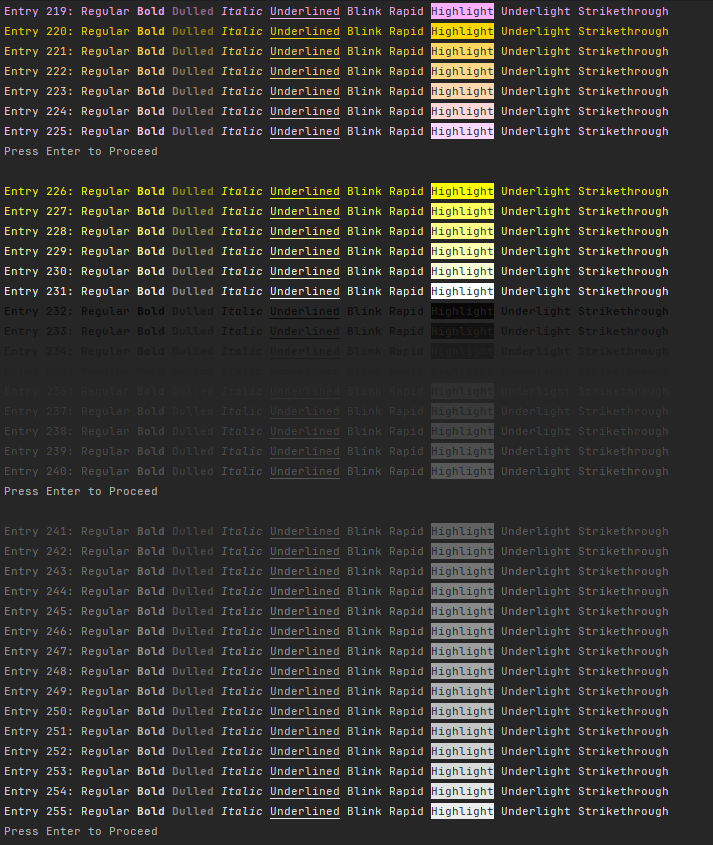
This was explained better in the Color Object, but here's what this does, iterates over every possible color the object can use, creates a Color256 for the BaseColor, creates a line in which sets that color and states the current Entry Number, iterates over all possible types, creates a Color256 for the Type, appends it to the printed line in the form of a Set, Say, Unset, once it's done iterating the types it prints the line, and appends an unset for the iterated color, every 15 goes it pauses to let the user read the entries and see what each are. Then, follows suit with the normal Press Enter To Proceed so that the app doesn't just close out once all entries are gone through.
ColorRGB
This Object is similar to the Color and Color256 Objects, however here's the kicker, ColorRGB supports all RGB Colors!!! Plus we have some extensions to convert Gray, HSL/HSV, and Hex codes into RGB, which will be covered in the next section.
Getters and Setters
Let's start by covering the Getters and Setters of the Object
| Entry | What it is and or is used to do |
|---|---|
| BaseString | This is the base of the ANSI Escape Code for Colors. |
| Type | The effect being applied to the Text Processor, this is in the form of a Integer |
| BasicShade | This is the shade after the constructors run through their logic, the first 1-2 digits are whether its background or foreground, and the last digit is the shade. |
| Red | This is the Red value of the RGB passed in. |
| Green | This is the Green value of the RGB passed in. |
| Blue | This is the Blue value of the RGB passed in. |
| Reset | A bool determining whether the Object classifies as a Reset or not, |
| Background | A bool determining whether the Object classifies as a Background or not. |
With that out of the way lets delve into the Constructors in which are provided.
Constructors
The below table is associated with the first variable of the constructor; the Types e.g. the Text Processing Modes in which are provided for ANSI.
Type List;
| Input | Description | Integer Input |
|---|---|---|
| Regular | The regular old fashioned color display system that just changes the color | 0 |
| Bold | The Bolded Version of the old fashioned color display, it changes both the color, and makes the text bolded or brighter. | 1 |
| Dulled | The Darkened Version of the old fashioned color display, it changes both the color, and makes the text dulled or darker. | 2 |
| Italic | The Italic version of the old fashioned color display, it changes both the color, and makes the text slanted. | 3 |
| Underlined | The Underlined version of the old fashioned color display, it changes both the color, and makes the text appear with a line beneath it. | 4 |
| Blink | The Flashy version of the old fashioned color display, it changes both the color and makes the text blink on and off slowly. | 5 |
| Rapid | The Flashy version of the old fashioned color display, it changes both the color and makes the text blink on and off rapidly. | 6 |
| Highlight | The Highlighter version of the old fashioned color list, it changes both the color, and makes the foreground [text] and background invert there colors giving off the effect that it is being highlighted. | 7 |
| Underlight | The Invisible version of the old fashioned color list, it changes both the color, and and makes it so that when the text is highlighted with the cursor it will show the text contents. | 8 |
| Strikethrough | The Strikethrough version of the old fashioned color list, it changes both the color, and puts a line e.g. a strike through the text being displayed. | 9 |
| Doubleline | The Doubleline version of the old fashioned color list, it changes both the color, and puts a line under the text, with another line under that line | 21 |
| Overline | The Overline version of the old fashioned color list, it changes both the color, and puts a line over the text. | 53 |
| Framed | The Framed version of the old fashioned color list, it changes both the color, and puts a box around the text. | 51 |
| Encircled | The Encircled version of the old fashioned color list, it changes both the color, and puts a circle around the text. | 52 |
Doubleline, Overline, Framed, and Encircled are part of version 1.2.0+ of the library.
Okay now back to the Constructor, After the Type you chose, there are 3 parameters that follow these correlate with; Red, Green, Blue, each are a 0-255 integer, there are also 2 optional bool's all defaulting to false, here's how they work;
- Reset - Marks the Object as a Reset Object and makes the appropriate reset object.
- Background - Marks the Object as a Background Object and makes the BasicShade take the form of a Background in the code,
Some takeaways about these 2 items;
- Reset is done by checking the Type, so if you want to reset the color and a type at the same time you'll need at least a ColorRGB Object with just the color change, and a ColorRGB Object with the Type Change than call
.GetReset().Format()on both to do the same effect, we may add a Function that gets a "Full" reset of sorts in the future. - When turning these markings on you need to do something like
reset: truein the constructor, this way the order isn't relevant, and you don't need to dofalseon all properties irrelevant, as they all default false.
GetReset()
This function pretty much just says, hey this is our current object, lets just pass back the same object EXCEPT, reset is marked as True. This works because you need to do .Format() in order to get the code anyhow, and both the constructor and the .Format() handle reset Objects already.
GetTypeString()
This function pretty much just says oh, we have this Type, and we had a String switch already to make it an integer, lets reverse the integers last digit back to the original string and send that back. This has little to no use case off the top of my head and is mainly utilized for the Displayer associated with the Color object.
Format()
This function is vital to displaying the Code onto the screen so it takes affect. What this does well, in laymen's terms it formats the Variables in the Object into a Proper ANSI Escape Code for Colors. Though it's a bit more complex, and I'd recommend checking out the code to see the full of what it does! Same for the Constructors if you have not!
GetTypeVariant(string/int type) (1.1.0+)
This function essentially says, so this is our current object, lets take that and give it the type your after.
GetColorVariant(int red, int green, int blue/Tupple(int red, int green, int blue)) 1.1.0+
This function does similar to GetTypeVariant() however, it affects the set color instead.
ToggleBackground() (1.1.0+)
This function just switches the State of the Foreground to Background and vice versa for the Object given.
Displayer
So while we do have a Displayer with Displayer.DisplayColorRGB(), it will take an hour or so to complete so, I would advise instead opening an Art Program or similar and using the Color Picker to choose a color. Plus it also doesn't have a functional [had a pause but, it only worked in one iteration of green so removed it] pausing system.
That said if anyone makes a video slowed down of the Displayer running I can link it here, because it is really satisfying to watch and pretty useful for seeing what works against the console or not, just would not recommend the current system for it!!!
Calls
These examples are pretty much the same as Color and Color256's so these won't be too wordy as its already explained twice!
Example 1
public static void Test()
{
    Console.WriteLine("Test 9");

    ColorRGB grayBG = new ColorRGB("Regular", 64, 56, 56, background:true);
    ColorRGB degrayBG = new ColorRGB("Regular", 64, 56, 56, reset: true, background:true);
    ColorRGB highlightGrayBG = new ColorRGB("Highlight", 64, 56, 56, background:true);
    ColorRGB delightGrayBG = new ColorRGB("Highlight", 64, 56, 56, reset: true, background:true);

    Console.WriteLine($"{grayBG.Format()}This is a {highlightGrayBG.Format()}ANSI{delightGrayBG.Format()} Test{degrayBG.Format()}, test complete");
    Console.ReadLine();
}
Taken in JetBrains Rider

Within this example, again we make 4 Color Objects this time ColorRGB, 2 sets, 2 unsets, all associated with RGB(64, 56, 56). After we set these up we print a testing message in the vein of; Turn color on for the background, Turn Highlight on, turn Highlight off, turn color off for the background. Note once more that the .Format() is required for it to print properly.
Example 2
This one's more complex but as an Example here is our current RGB Displayer setup.
Console.WriteLine("Foreground");

for (int r = 0; r < 256; r++)
{
    for (int g = 0; g < 256; g++)
    {
        for (int b = 0; b < 256; b++)
        {
            ColorRGB baseColor = new ColorRGB(0, r, g, b);
            string LinetoPrint = $"{baseColor.Format()}Entry {r}, {g}, {b}: ";

            for (int type = 0; type < 10; type++)
            {
                ColorRGB typedColor = new ColorRGB(type, r, g, b);
                LinetoPrint += $"{typedColor.Format()}{typedColor.GetTypeString()}{typedColor.GetReset().Format()} ";
            }

            Console.WriteLine(LinetoPrint + $"{baseColor.GetReset().Format()}");
        }
    }
}

Console.WriteLine("Press Enter to Proceed");
Console.ReadLine();
Taken in Microsoft Command Prompt
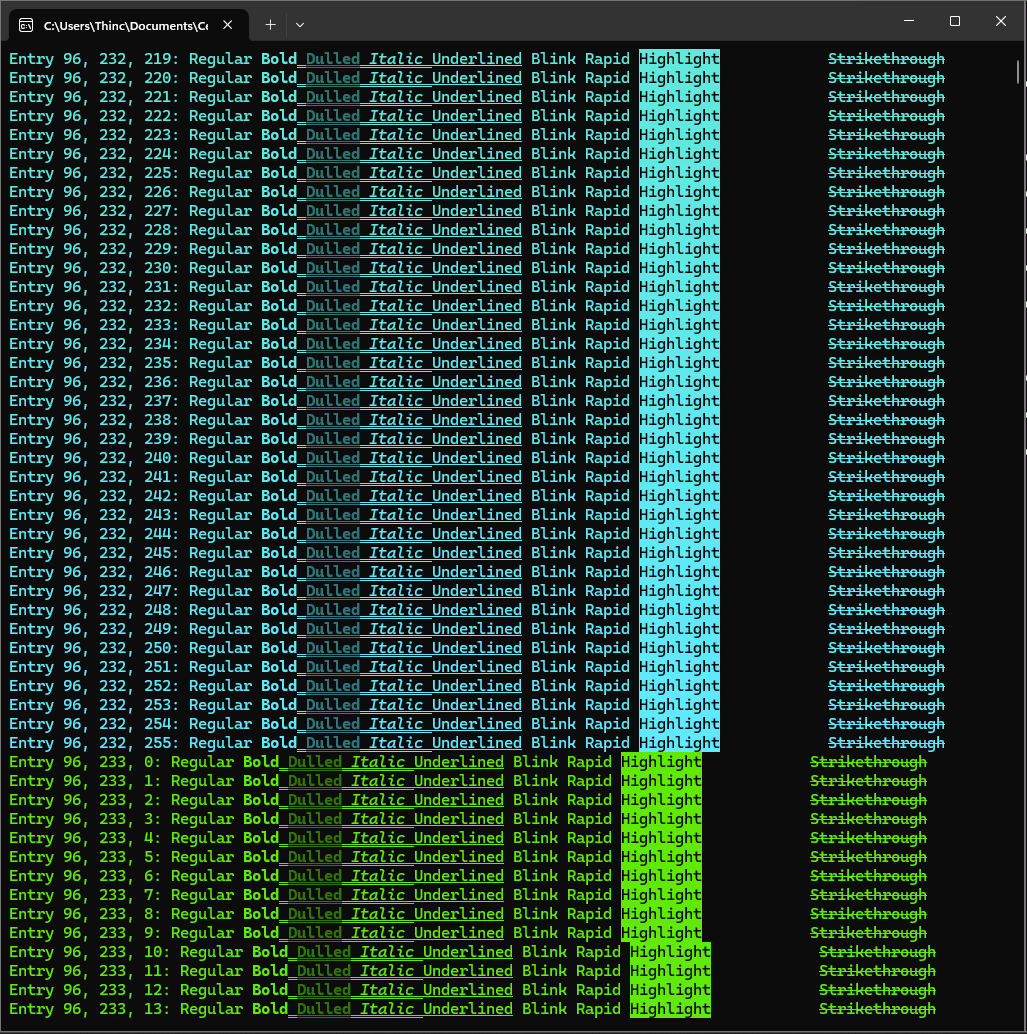
So what this does is essentially starts a loop through all 256 shads of red, followed by all 256 shades of green, followed by all 256 shades of blue. Once we are in the Blue loop we set up the iterator color, filling in a 0 for Normal color, and the r, g, and b iteration values. Afterwards we start the print line of Color On, Entry R G B. Than we loop through all possible types, and create a typed color in that loop. With that typed color we add to the printing line essentially Turn Type On, Print Type, Turn Type Off and Space, this repeats until we reach the end of the code block for the loop. Once we exit the type loop we add Color Off and print the line. This one doesn't have a pause, frankly because I couldn't get it working, which is why I do not recommend it. However, it's beautiful to watch.
RGB Conversions
Now let's dig into the RGB Convertors and how to use them. As of 1.1.0 you can now pass the output tupples directly into the ColorRGB Object.
FromHex(string Code)
For this one you simply need to pass in either something like "#ffffff" or "ffffff", because hex is base 16 it must be a string. How it works internally is trimming the start of the code of #'s, than converting each split of 2 characters in the code from base 16 into base 10, than returns the RGB values that were outputted.
Now here's an example from the Tester of how you can use it.
Example 1
public static void Test()
{
    Console.WriteLine("Test 11");

    (int r, int g, int b) = ConvertFromXToRGB.ConverToRGBFromHex("#aa55cb");

    ColorRGB hex = new ColorRGB("Regular", r, g, b);
    ColorRGB dehex = new ColorRGB("Regular", r, g, b, reset: true);

    Console.WriteLine($"Let's give this {hex.Format()}hex (#aa55cb){dehex.Format()} conversion a test. Resultants; {r}, {g}, {b}");
    Console.ReadLine();
}
Taken in JetBrains Rider

So here's what this piece of code is doing, First it gets the RGB pair from the Hex Conversion of "#aa55cb". Then it takes that color and makes two ColorRGB's from it, setting the mode to Regular (e.g. normal color), followed by the returned R G B from the hex conversion, one a reset one a set. Lastly it prints a line attempting to see if the color converted properly with a Format() for turning the Hex on and off, and feeds back the results it got from the math it did. And that's pretty much all there is to it!!
FromGrayscale(int Gray)
So code wise this is the simplest one by far, essentially what it does is take the passed in gray and set that gray to each R G B value and returns it.
Here's an Example from the Tester on how to use it!!
Example 1
public static void Test()
{
    Console.WriteLine("Test 10");

    (int r, int g, int b) = ConvertFromXToRGB.ConvertToRGBFromGrayscale(134);

    ColorRGB grayscale = new ColorRGB("Regular", r, g, b);
    ColorRGB degrayscale = new ColorRGB("Regular", r, g, b, reset: true);

    Console.WriteLine($"Let's give this {grayscale.Format()}grayscale (134){degrayscale.Format()} conversion a test. Resultants; {r}, {g}, {b}");
    Console.ReadLine();
}
Taken in JetBrains Rider

Code wise this does the same thing as the HEX conversion, however it is a grayscale instead, and yes the Resultants should be the same number ats the input three times.
FromHueShadeValue(int hue, int shade, int value)
This one's probably one of the trickier ones to explain on a coding frontier plus its off slightly in rounding but here's what it does;
- Takes the Shade and Value and Divides them by 100f into a Float.
- Calculates the Difference by doing the Shade and Value results from step 1 and multiplying them.
- Solves for "X", by taking the Difference we just got and Multiplying it by 1 subtracted by the Absolute value of Hue/60f mod 2 subtracted by 1.
- Gets the Missing value by doing the Value value retrieved in step 1 subtracted by the Difference.
- Next it determines a Quadrant in which the HSV color falls into and calls
BackToRGB()for the associated combination. - in
BackToRGB()it takes the floats passed in and does the following to the RGB values.- Gets the Maximum comparatively between the Value to 0f.
- Gets the Minimum comparatively to that Maximum to 1f.
- Multiplies that minimum by 255.
- Rounds the Product of the multiplication.
- Casts the rounding into an Integer.
- In the case it fails to land a Quadrant it returns a 0,0,0 otherwise it returns the result from Step 6.
Now here's an example of how you can use it without needing to know all of that Math!
Example 1
public static void Test()
{
    Console.WriteLine("Test 12");

    (int r, int g, int b) = ConvertFromXToRGB.ConvertToRGBFromHueShadeValue(283, 58, 79);

    ColorRGB hsv = new ColorRGB("Regular", r, g, b);
    ColorRGB dehsv = new ColorRGB("Regular", r, g, b, reset: true);

    Console.WriteLine($"Let's give this {hsv.Format()}hsv (283, 58, 79){dehsv.Format()} conversion a test. Resultants; {r}, {g}, {b}");
    Console.ReadLine();
}
Taken in JetBrains Rider

Again similar to the last two code wise except this time it converts from an HSV pair to an RGB. Also, the R and B value are off by 2 digits from the math not sure as to where it stems but yeah ^^
FromHueSaturationLightness(int hue, int saturation, int lightness)
This one is also one of the trickier ones code wise but here's what it does broken down.
- Takes the saturation and lightness and divides them by 100f.
- Calculates the Difference from the following equation; 1 subtracted by the Absolute value of 2 multiplied by the light value from Step one, subtracted by 1, than after all of the prior multiplying by saturation also from the prior step.
- Solves for "X" by taking the Difference and multiplying it by 1 subtracted by the Absolute value of Hue/60f mod 2 subtracted by 1.
- Gets the Missing value via Light from Step 1 subtracted by the Difference divided by 2.
- Next it determines a Quadrant in which the HSL color falls into and calls
BackToRGB()for the associated combination. - in
BackToRGB()it takes the floats passed in and does the following to the RGB values.- Gets the Maximum comparatively between the Value to 0f.
- Gets the Minimum comparatively to that Maximum to 1f.
- Multiplies that minimum by 255.
- Rounds the Product of the multiplication.
- Casts the rounding into an Integer.
- In the case it fails to land a Quadrant it returns a 0,0,0 otherwise it returns the result from Step 6.
Alright now let's get into the example from the Tester
Example 1
public static void Test()
{
    Console.WriteLine("Test 13");

    (int r, int g, int b) = ConvertFromXToRGB.ConvertToRGBFromHueSaturationLightness(283, 53, 56);

    ColorRGB hsl = new ColorRGB("Regular", r, g, b);
    ColorRGB dehsl = new ColorRGB("Regular", r, g, b, reset: true);

    Console.WriteLine($"Let's give this {hsl.Format()}hsl (283, 53, 56){dehsl.Format()} conversion a test. Resultants; {r}, {g}, {b}");
    Console.ReadLine();
}
Taken in JetBrains Rider

Again pretty much identical to the prior examples just this time it utilizes HSL instead, this one is off by 1 in the R and B and 2 in the G, again not sure where the rounding errors stem from.
ColorBaseTypeSwitch (2.0.0+)
This is a set of functions meant more so for internal use, that handles convering a string/int type into the proper type code used in the Color Objects.
ColorTypeSwitch (2.0.0+)
Child specific functions for getting the color from a string or int as a int and for creating the BasicShade variable.
GetDigitStart (2.0.0+)
This handles getting the digit at the start of the BasicShade peice used within the Color Objects.
Credits;
- See Code Comments for more precise credits
- Chaosyr/SaxbyMod/Creator; The ANSI Lists (Obsolete), Color Objects, GetColorFromType (Obsolete), Conversions to RGB code, Displayer, GetDigitStart, ColorTypeSwitch, ColorBaseTypeSwitch the Full Documentation as it stands.
Attribution to Guides we looked at;
- For the Original List's they source from this Gist, and Chaosyr a few years back as of writing experimented to find out all the Types, and recently found out about the Rapid Blink mode, which is exclusive to the Color Objects; https://gist.github.com/RabaDabaDoba/145049536f815903c79944599c6f952a
- For the Color Object's we took a look at the following documentation to see if there was more we could do ANSI wise turns out RGB and 256 was a thing, same with separated Resets (not mentioned here, iwrc): https://gist.github.com/fnky/458719343aabd01cfb17a3a4f7296797
License(s);
Cecil Libraries License (1.0.0)
Copyright 2025 Cecil Libraries Organization and the Founder(s) Chaosyr
In the case where it so falls that a Sub-License and this License conflicts, this License dictates.
Also, any Licenses applied to this Product outside of this License are deemed as Sub-Licenses unless otherwise stated.
-
Key Terms
This section likely self-explanatory goes over any Key Terms that may be unfamiliar to those looking at this License and seeing if their Project breaks it.
- Founder
- The person who Originally made this Product. OR under the condition the Product does not come soley from them Definition 2 applies.
- The group behind a given Product.
- Organization
- The GitHub Team that houses all the Products that this License affects.
- Contributors
- Anyone who has contributed to the Product in any way shape and or form.
- Developer
- The person in which is using this Product for purposes of developing their own projects.
- Mod-Maker
- A Developer who is using this Product for purposes of making mods.
- Game Developer
- A Developer who is using this Product for purposes of developing their own games.
- End-User
- Anyone who is using this Product as bi-product of it being shipped with a Developers Project.
- Product
- The project in which this license was applied to.
- Project
- A developers work, be it from Cecil Libraries themselves, The Founder or A Developers.
- Founder
-
Founder Clause
This clause goes over all right's in which the Founder has over the Product this License affects.
- The Founder reserves the rights to what can or can not be done with their teams Product.
- If the Founder deems necessary to request a Developer's Project, to stop using this Product, or alternatively to alter its usage within The Developer's Project, The Founder has the right to request irregardless, however The Founder may only seek to enforce the usage, if the Developer's Project breaks this License or any of this Product's Sub-Licenses from the Founder or the Contributors.
- The Founder has the right to restrict any usage of this Product's associated IP's, for example, any Mascots, Assets, Fonts, Screenshots, or Example Code included in the Product or on the Organization's page for the Product.
-
Contributor's Clause
This will both go over any right's Contributors have over their code included in the Product, and any requirements for their contribution's to this Product.
-
Right's of the Contributor
This sections goes over all right's in which the Contributor has over the usage of their Code within the Product this License affects.
- The Contributor may put their own License on this Product, under the condition it does NOT violate any rights given by this License over the Product's usage.
- On the case that a Developer breaks your License, it must be sent into headway to the Founder of this Product.
- A Contributor's License will only apply to parts of the Codebase in which The contributor is attributed to in the Code Comments.
- If A Contributor breaks the License of another Contributor, the Contributor that broke it must adhere to whatever policy the Contributor that made it has.
- All Sub Licenses to the Product must be reviewed both by the Organization and by the Founder, before inclusion, this is done to prevent any too heinous of Licenses from inclusion.
-
Responsibilities of the Contributor
This section goes over all responsibilities Contributors must follow when working with this Product's Code Base.
- The Product's Source Code must remain Open-Source as long as this License stands on this Product.
- The Product's Source Code and the Code the Contributor added into the Source Code must have full explanation in the form of XML comments, these comments must Include all the following when applicable; Summary, Param Name descriptions, Returns, and a Remarks containing credits that lead back to The Contributor and how The Founder, another Contributor, or a Developer, may contact zed Contributor if need be in the future.
- Any Code that The Contributor deems to be Obsolete must be marked with
[Obsolete]in the code base and may not be deleted. - The Contributor's Code must NOT break any functionality of another function, class or project.
- Any Commits you make must have a full and complete bullet pointed list of changes made in the Commit.
-
-
Developer's Clauses
This section will go over 3 clauses related to Developers along with a generalized set of rights among all Developers.
-
Mod Makers Clause
This section will go over usage of this Product by Mod Makers.
- If this Product needs to be placed onto a modding site, rather than including it with The Developers Project stand alone and or uploading it as a separate Project, contact the Founder or the Organization to have the Product placed onto the given site.
- If the Developer must have the Product shipped with their Project, the Project must list any and all licenses placed upon the Product in some way, shape or form, and on the site hosting the Developers Project, it must state that this Product is shipped with it.
- If the Founder or Organization deems it necessary, they may get the Developers Project taken down, with allowance for it to go back up under the following condition; The Project uses this Product from a package uploaded to zed site by the Organization or Founder.
-
Game Developer's Clause
This section will go over usage of this Product by Game Developers.
- This Product may be shipped with the Developers Project, as long as there is a link back to any and all licenses placed upon the Product in some way, shape, and or form.
- If this Product needs to be placed onto an asset store or similar, contact the Founder or the Organization to have the Product placed onto the given site.
-
Software Developer's Clause
This section will go over usage of this product by Software Developers.
- This product may be shipped with the Developer's Project, as long as there is a link back to any and all licenses placed upon the Product in some way, shape, and or form.
- If this Product needs to be placed onto any site in which the Project from the Developer needs it, contact the Founder or the Organization to have the Product placed onto the given site.
- The Developer may ask for certain functionality be added to the Product to the Founder or Organization, however there is no guarantee it will happen, quick, or soon, in the case it doesn't get added, you may add it yourself to the Product via contribution, or you may make an Extension Product that extends upon this Product, this License must be shipped with it.
-
Developer's Clause
This section will go over usage of this product by all Developers, this clause also applies to the aforementioned Developer's as well.
- The Developer must utilize this Product as it was intended, do not utilize it for the purpose of exploiting what it does for unfair gain.
- The Developer must not decompile this Product in any way, shape, or form, it is open source for a reason, look at the direct source code if needed to see what the Product is doing.
- Try and stray away from reuploading this Product to another site, if it is needed as stated a couple of times now, contact the Founder or Organization for it to be listed.
- The Developer may request for functionality to be added, if deemed necessary contact the Founder of the Product for the functionality, but first check if the Organization behind it has another Product that adds the Functionality sought.
- Any Developer may contribute to this Product, however they must follow the Contributors Clause as well.
-
-
End User's Clause
This section will go over the rights of the End User, i.e. the Consumer who has this Product installed from another Project that uses the Product.
- If the End User finds Exploits, Bugs, or any of the likes, contact the Founder directly so it can be resolved immediately.
- The user may not alter this Product for purposes of altering a Developer's Project and how it works.
- If deemed necessary the Organization or Founder may add more restriction's to this Section.
SaxbyMod's License (Branched off of the MIT License)
Copyright 2025 SaxbyMod
Permission is hereby granted, free of charge, to any person obtaining a copy of this software and associated documentation files (the “Software”), to deal in the Software without restriction, including without limitation the rights to use, copy, modify, merge, publish, distribute, sublicense, and/or sell copies of the Software, and to permit persons to whom the Software is furnished to do so, subject to the following conditions:
The above copyright notice and this permission notice shall be included in all copies or substantial portions of the Software. Additionally, any software that is published, or derived from this project must credit the author(s) of this project. If this is to be published code may not match in a 1:1, there must be some alteration.
Alterations not allowed would be for example changing of comments, stripping of comments, adding of comments, changing variable names, changing variable types, or adding or removing variables that make no change to the code.
THE SOFTWARE IS PROVIDED “AS IS”, WITHOUT WARRANTY OF ANY KIND, EXPRESS OR IMPLIED, INCLUDING BUT NOT LIMITED TO THE WARRANTIES OF MERCHANTABILITY, FITNESS FOR A PARTICULAR PURPOSE AND NONINFRINGEMENT. IN NO EVENT SHALL THE AUTHORS OR COPYRIGHT HOLDERS BE LIABLE FOR ANY CLAIM, DAMAGES OR OTHER LIABILITY, WHETHER IN AN ACTION OF CONTRACT, TORT OR OTHERWISE, ARISING FROM, OUT OF OR IN CONNECTION WITH THE SOFTWARE OR THE USE OR OTHER DEALINGS IN THE SOFTWARE.
Cecil.Bridge (v1.0.0)
Copyright 2026 Cecil Libraries Organization and the Founder(s) Chaosyr
- NUGET Package Link: https://www.nuget.org/packages/Cecil.Bridge/1.0.0
- Full Version Changelog: https://github.com/Cecil-Libraries/Cecil-Bridge/commits/V1.0.0
- Support Discord: https://discord.gg/8yDjSXzvgu
FAQ's/Project Intro
What is Cecil Libraries?
Cecil Libraries are a group of libraries in which extend functionality to many API and provide utilities as a Pseudo-API for several necessity's.
Who is Cecil?
Both a Member of the Vessel Chaosyr, and the Mascot of our Libraries. Mascot wise she is as originally described by Chaosyr "10ft tall, raven, succubus, whom is Bi, Poly, and a Femboy". That's as far as we are with her at the moment, if more details arrive it will be on the Organizations main page, figured we'd fill in for the case anyone's wondering what the logo stems from.
What is this Library for?
This library is primarily for enabling the ability to send messages back and forth between 2 different runtimes. This is intended for usage in the case where you need Modern API's back in a runtime using a severely outdated net version. For example, in the case where you need DSharp+ [net9.0 library] in a BepInEx mod [in this example on netframework3.5]. It's pretty simple to do and use, as long as you have a way of mapping paths for both ends so they can communicate, and having a way they can reach a text file that they would both read, note the library in present wont make the file.
Library Documentation (Bridge)
This will probably be easier to navigate through in the GitHub's Wiki, however this will just be as in depth as the Wiki will be, so everything you need will be within this very file, the Code is also fully commented if you wish to jump straight into coding. If any explanations are weaker than other let us know so we can fix it up!
Initializing a Sender
To initialize a Sender, all you really need is a Path to the other end that you are intending to reach. But let me explain how the Sender is utilized within the Messenger system. The Sender affectively is a path associated with the question of Where do we send the message off to. It's an Object so that it can more easily be changed and for the case that it would be good to have functions under the Sender itself as well.
How do I initialize the Sender?
Well to Initialize it all you really need to do is this;
Sender sender = new Sender([INSERT FULL PATH TO DLL]);
In present you will need to make the logic for fetching the path, it will become much easier when we make Cecil.Pathing_Utils. But while I'm at it here are some useful functions to help guide you;
Assembly assembly = Assembly.GetExecutingAssembly();
string DLLPath = Path.GetDirectoryName(assembly.Location);
The above gets the full DLLPath to where the DLL is located.
Initializing a Receiver
To initialize a Receiver, again all you really need is a Path, this time to the executing run time. The Receiver is used in the Messenger as a Where do messages we send out return back to, this doesn't have to be this run time for record, but its intended for the current runtime running the code to send the message. It's also a Object for the case where we would want to have functions associated with the Receiver itself.
How do I initialize the Receiver?
To initialize it what you do once more is pretty much just this;
Receiver receiver = new Receiver([INSERT FULL PATH TO DLL]);
In present you will need to make the logic for fetching the path, unless you are running from the DLL the messenger will receive the message back from, we'll have better Pathing utilities in our planned library for pathing! But for getting the current executing run time heres what we do;
Assembly assembly = Assembly.GetExecutingAssembly();
string DLLPath = Path.GetDirectoryName(assembly.Location);
Receiver receiver = new Receiver(DLLPath + "\\Orpheon_Bot.dll");
What this does is fetches the full path from the executing run time, than appends the DLL in which it will receive to, in this case Orpheon_Bot.dll.
Initializing and Working with the Messenger
Now this is the not so simple and somewhat complex core component to this whole bridge; the Messenger. It's job is to send messages to the Sender and track when a Message is sent either to it or back to it. Pinging for the message is logic you will need to create in present until we have one built into the project.
How do I initialize the Messenger?
For this one its again just a Object creation;
Messenger messenger = new Messenger([YOUR SENDER], [YOUR RECEIVER], [PATH TO THE TEXT FILE IN WHICH THIS WILL SEND AND RECEIVE MESSAGES]);
Again you'll need to do the pathing logic yourself, and will need to create the path to the destination wanted. Before we move on let me show you how messages are shown in present;
SendsTo;Mesage;Key;SendBackTo
"C:\Program Files (x86)\Steam\steamapps\common\Pony Island\Orpheon\Orpheon_Bot.dll";"eDJ6RCthdml0bEpLbG1wWjFhMlF4L2d6Sno4aUJITmpMblNZVUtzOWtyNENEemtZOWFyM1pNWStQekVpa1RWemVZc0pZMFJmUUFocHRNQ1Q3UXRiNXRBc0dhU0svNUdFdVp3MnZyOFVJaVVMNUk4WFQ0ZGpIRDhNL2xFZitOSkJoS0w2WTlJaFVWU0FKTk1zRDdtbFRBPT0gQXBwbGU=";"x2zD+avitlJKlmpZ1a2Qx/gzJz8iBHNjLnSYUKs9kr4CDzkY9ar3ZMY+PzEikTVzeYsJY0RfQAhptMCT7Qtb5tAsGaSK/5GEuZw2vr8UIiUL5I8XT4djHD8M/lEf+NJBhKL6Y9IhUVSAJNMsD7mlTA==";"C:\Program Files (x86)\Steam\steamapps\common\Pony Island\BepInEx\plugins\Challenges\Pony Island Challenge Runs.dll"
The key on line 1 should help with how to read this but essentially, SendsTo is the string passed in from the Sender e.g. the Path, Message is the Base64 message mixed in with a Key, Key is the base64 key so the system can decrypt the messages, and lastly the end path is where messages will be sent to after the Receiver for where the message was sent does its job if that makes sense.
How do I utilize the Messenger?
To utilize there are a few functionalities you will need to know, let's go through each one!
Object Variables;
These are some variables that would be good to know if your using the Messenger system!
Sender
The sender of the messenger.
Receiver
The receiver of the messenger.
Message
This is the variable in which the received decrypted message will be found within.
MutualFilePath
This is the mutual file path referenced by the Sender and Receiver
Private Object Variables
These are some of the private variables used within the Messenger to help do its job.
PreviousLine
Internal variable used for checking whether the prior received message is the same as the current one.
RetPeices (more or less a sub record)
This is used for certain returns across the class since the lovely Tupples dont exist in this framework. This is used to transfer the key and message back to the function checking for them.
Functions of the Messenger
This is the core section that you'll need for using the Messenger!
Public Void SendMessage(string Message)
This is the function that essentially starts the chain for sending a message. It takes a string representing the exact message you want to send across, all sending and receiving is done via strings.
Private RetPieces EncryptMessage(string Message)
This method essentially makes a random key of byte of size 32-128, encrypts it to Base64, than gets the byte form of the message with the key in front, than takes those bytes and turns it into base64 and returns the base64 key and message.
Private Void StoreMessage(Receiver receiver, RetPeices ret, Sender sender)
This will create or overwrite the messenger file given, and chuck in the key for user reading, and the message sender.SendsTo, message, key, receiver.ReceivesFrom to be read by the receiving end.
Public Bool ReceiveMessage()
This is a check for if a message has been received, and if so, it follows through with the logic of setting the Messengers message to the received message.
Private String DecryptMessage(String message, String key)
This is a method used to Decrypt the message from Base64 and return it back to the receiving check.
How could I ping for Updates in the messenger?
Well there's 2 options we have made in present one a ASYNC the other a Courotine (the Courotine less tested). Mind you the first is written in .NET 9 while the latter is .NET Framework3.5.
Net9.0 Async example
public static string waitForMessageAndReturn(Messenger messenger)
{
    while (!messenger.ReceiveMessage())
    {
        Thread.Sleep(100);
    }
    return messenger.message;
}

public static async Task RunWaiting(Messenger messenger)
{
    while (true) {
        string message = waitForMessageAndReturn(messenger);
        if (message.Contains("Apple"))
        {
            Console.WriteLine("Received Key 'Apple'.");
            messenger.SendMessage("Heeding your call sir! Here's your key [Bannana]");
        } else {
            Console.WriteLine("Received invalid Key.");
        }
	}
}
You may notice there are 2 functions, and thats absolutely intentional!
WaitForMessageAndReturn() in this example is a function that essentially says Hey when im called let me indefinitely check if theres a message, and if I see one return the decrypted message to the function that called me.
RunWaiting() is a Async method which runs in the background while the rest of the code base runs, what does it do? well it Pings for a message return indefintely and when it gets one it checks the message for a Key for example here Apple than decides what to do in this case say it received the key and send a message back. It can be as complex as needed, it can even be broken into sub functions, classes and modules, this is just a baseline!!
Oh yeah bonus, to call it, it is as simple as RunWaiting(messenger); in your Awake or however you want to initalize the ping check.
NetFramework3.5 Example
public IEnumerator Check(Messenger messenger)
{
    while (true)
    {
        if (messenger.ReceiveMessage())
        {
            if (messenger.message.Contains("Bannana"))
            {
                PonyIslandChallengeRuns.CodeBaseLogger.LogInfo("Received Key 'Bannana'.");
                messenger.SendMessage("Heeding your call sir! Here's your key [Apple]");
            } else {
                PonyIslandChallengeRuns.CodeBaseLogger.LogError("Received invalid Key.");
            }
        }
        yield return new WaitForSeconds(0.1f);
    }
}
This is the rough Async equivalent for NetFramework3.5; a Courotine.
For record to start it you would do; StartCoroutine(new MessageReceivedCheck().Check(messenger));
How does it work? Well, its essentially a Enumerator which will indeifinitely check if a Message was received, if it was we do the key thing this time the key is Bannana, if it was not we wait a second and loop again.
Credits;
- See Code Comments for more precise credits
- Chaosyr/SaxbyMod/Creator; The Sender, Receiver, and Messenger logic and code.
License(s);
Cecil Libraries License (1.0.0)
Copyright 2026 Cecil Libraries Organization and the Founder(s) Chaosyr
In the case where it so falls that a Sub-License and this License conflicts, this License dictates.
Also, any Licenses applied to this Product outside of this License are deemed as Sub-Licenses unless otherwise stated.
-
Key Terms
This section likely self-explanatory goes over any Key Terms that may be unfamiliar to those looking at this License and seeing if their Project breaks it.
- Founder
- The person who Originally made this Product. OR under the condition the Product does not come soley from them Definition 2 applies.
- The group behind a given Product.
- Organization
- The GitHub Team that houses all the Products that this License affects.
- Contributors
- Anyone who has contributed to the Product in any way shape and or form.
- Developer
- The person in which is using this Product for purposes of developing their own projects.
- Mod-Maker
- A Developer who is using this Product for purposes of making mods.
- Game Developer
- A Developer who is using this Product for purposes of developing their own games.
- End-User
- Anyone who is using this Product as bi-product of it being shipped with a Developers Project.
- Product
- The project in which this license was applied to.
- Project
- A developers work, be it from Cecil Libraries themselves, The Founder or A Developers.
- Founder
-
Founder Clause
This clause goes over all right's in which the Founder has over the Product this License affects.
- The Founder reserves the rights to what can or can not be done with their teams Product.
- If the Founder deems necessary to request a Developer's Project, to stop using this Product, or alternatively to alter its usage within The Developer's Project, The Founder has the right to request irregardless, however The Founder may only seek to enforce the usage, if the Developer's Project breaks this License or any of this Product's Sub-Licenses from the Founder or the Contributors.
- The Founder has the right to restrict any usage of this Product's associated IP's, for example, any Mascots, Assets, Fonts, Screenshots, or Example Code included in the Product or on the Organization's page for the Product.
-
Contributor's Clause
This will both go over any right's Contributors have over their code included in the Product, and any requirements for their contribution's to this Product.
-
Right's of the Contributor
This sections goes over all right's in which the Contributor has over the usage of their Code within the Product this License affects.
- The Contributor may put their own License on this Product, under the condition it does NOT violate any rights given by this License over the Product's usage.
- On the case that a Developer breaks your License, it must be sent into headway to the Founder of this Product.
- A Contributor's License will only apply to parts of the Codebase in which The contributor is attributed to in the Code Comments.
- If A Contributor breaks the License of another Contributor, the Contributor that broke it must adhere to whatever policy the Contributor that made it has.
- All Sub Licenses to the Product must be reviewed both by the Organization and by the Founder, before inclusion, this is done to prevent any too heinous of Licenses from inclusion.
-
Responsibilities of the Contributor
This section goes over all responsibilities Contributors must follow when working with this Product's Code Base.
- The Product's Source Code must remain Open-Source as long as this License stands on this Product.
- The Product's Source Code and the Code the Contributor added into the Source Code must have full explanation in the form of XML comments, these comments must Include all the following when applicable; Summary, Param Name descriptions, Returns, and a Remarks containing credits that lead back to The Contributor and how The Founder, another Contributor, or a Developer, may contact zed Contributor if need be in the future.
- Any Code that The Contributor deems to be Obsolete must be marked with
[Obsolete]in the code base and may not be deleted. - The Contributor's Code must NOT break any functionality of another function, class or project.
- Any Commits you make must have a full and complete bullet pointed list of changes made in the Commit.
-
-
Developer's Clauses
This section will go over 3 clauses related to Developers along with a generalized set of rights among all Developers.
-
Mod Makers Clause
This section will go over usage of this Product by Mod Makers.
- If this Product needs to be placed onto a modding site, rather than including it with The Developers Project stand alone and or uploading it as a separate Project, contact the Founder or the Organization to have the Product placed onto the given site.
- If the Developer must have the Product shipped with their Project, the Project must list any and all licenses placed upon the Product in some way, shape or form, and on the site hosting the Developers Project, it must state that this Product is shipped with it.
- If the Founder or Organization deems it necessary, they may get the Developers Project taken down, with allowance for it to go back up under the following condition; The Project uses this Product from a package uploaded to zed site by the Organization or Founder.
-
Game Developer's Clause
This section will go over usage of this Product by Game Developers.
- This Product may be shipped with the Developers Project, as long as there is a link back to any and all licenses placed upon the Product in some way, shape, and or form.
- If this Product needs to be placed onto an asset store or similar, contact the Founder or the Organization to have the Product placed onto the given site.
-
Software Developer's Clause
This section will go over usage of this product by Software Developers.
- This product may be shipped with the Developer's Project, as long as there is a link back to any and all licenses placed upon the Product in some way, shape, and or form.
- If this Product needs to be placed onto any site in which the Project from the Developer needs it, contact the Founder or the Organization to have the Product placed onto the given site.
- The Developer may ask for certain functionality be added to the Product to the Founder or Organization, however there is no guarantee it will happen, quick, or soon, in the case it doesn't get added, you may add it yourself to the Product via contribution, or you may make an Extension Product that extends upon this Product, this License must be shipped with it.
-
Developer's Clause
This section will go over usage of this product by all Developers, this clause also applies to the aforementioned Developer's as well.
- The Developer must utilize this Product as it was intended, do not utilize it for the purpose of exploiting what it does for unfair gain.
- The Developer must not decompile this Product in any way, shape, or form, it is open source for a reason, look at the direct source code if needed to see what the Product is doing.
- Try and stray away from reuploading this Product to another site, if it is needed as stated a couple of times now, contact the Founder or Organization for it to be listed.
- The Developer may request for functionality to be added, if deemed necessary contact the Founder of the Product for the functionality, but first check if the Organization behind it has another Product that adds the Functionality sought.
- Any Developer may contribute to this Product, however they must follow the Contributors Clause as well.
-
-
End User's Clause
This section will go over the rights of the End User, i.e. the Consumer who has this Product installed from another Project that uses the Product.
- If the End User finds Exploits, Bugs, or any of the likes, contact the Founder directly so it can be resolved immediately.
- The user may not alter this Product for purposes of altering a Developer's Project and how it works.
- If deemed necessary the Organization or Founder may add more restriction's to this Section.
SaxbyMod's License (Branched off of the MIT License)
Copyright 2026 SaxbyMod
Permission is hereby granted, free of charge, to any person obtaining a copy of this software and associated documentation files (the “Software”), to deal in the Software without restriction, including without limitation the rights to use, copy, modify, merge, publish, distribute, sublicense, and/or sell copies of the Software, and to permit persons to whom the Software is furnished to do so, subject to the following conditions:
The above copyright notice and this permission notice shall be included in all copies or substantial portions of the Software. Additionally, any software that is published, or derived from this project must credit the author(s) of this project. If this is to be published code may not match in a 1:1, there must be some alteration.
Alterations not allowed would be for example changing of comments, stripping of comments, adding of comments, changing variable names, changing variable types, or adding or removing variables that make no change to the code.
THE SOFTWARE IS PROVIDED “AS IS”, WITHOUT WARRANTY OF ANY KIND, EXPRESS OR IMPLIED, INCLUDING BUT NOT LIMITED TO THE WARRANTIES OF MERCHANTABILITY, FITNESS FOR A PARTICULAR PURPOSE AND NONINFRINGEMENT. IN NO EVENT SHALL THE AUTHORS OR COPYRIGHT HOLDERS BE LIABLE FOR ANY CLAIM, DAMAGES OR OTHER LIABILITY, WHETHER IN AN ACTION OF CONTRACT, TORT OR OTHERWISE, ARISING FROM, OUT OF OR IN CONNECTION WITH THE SOFTWARE OR THE USE OR OTHER DEALINGS IN THE SOFTWARE.