
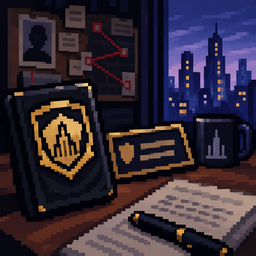
DetectiveRoutine
Join an Enforcer Division as a staff detective: shifts, reports, pay, search warrants, a badge, and enforcers who brief you at the scene.Detective Routine
Be a detective on the city's payroll, not just a stranger with a lockpick. Join an Enforcer Division, keep your shifts, write your reports, collect your pay, and get the paperwork that lets you go where a private eye can't.
Recommended
I strongly recommend playing this mod together with:
- SOD Life and Living by Venomaus: its economy rebalance makes a detective's salary actually matter.
- DialogUIRework by Piepieonline: the mod adds quite a few lines to conversations, and they go neatly into its tabs.
Optional: with PartialPrints by Macawesome75 installed, you get a fingerprint lab to send prints to (see below).
Joining the force
Apply at the front desk in the City Hall lobby. A few hours later you are assigned to one of the city's Enforcer Divisions that has a free desk. A welcome letter from your captain tells you where to report and when your shifts are. You can resign at the same desk.
Until you join, the game plays as usual.
Once you're in:
- You can go anywhere in your division's premises, like any other employee.
- You have your own account on the division's crunchers, so you can read your mail there even if you have no home.
- You get your own desk, with its cruncher and drawers, and a name placard on it. Your photo goes up on the employee board.
- You are listed in the Gov Database and in your division's Employee Database.
Shifts
Day shifts, Monday to Friday, 9 to 5 (configurable). Sign in at a cruncher in your division when your shift starts; you get a reminder an hour before. Up to an hour late counts as late. After that, the shift is missed.
Call-outs. When a murder victim is found outside your shift, your captain calls you out by vmail: be at the scene within 3 hours. Walking in or asking the enforcer on the door to let you in both count. Make it in time and it's an emergency shift, paid at one and a half times the usual once you file the crime scene write-up. Miss it and you just miss the money; it's not a strike. If the body turns up during your shift, it's just work: no extra pay, but getting to the scene counts as signing in, so you won't be marked late for going straight there. If your shift ends in less than 3 hours, it's a proper call-out after all, since you'll be working past it.
Reports
The Reports Due app on Enforcer office crunchers lists what you owe:
- a shift report, near the end of every shift you signed in for;
- an explanation, when you were late or missed a shift;
- a crime scene write-up, for every murder scene you visit; the more evidence on your board is linked to the scene or the victim, the longer it takes;
- a case report, when you hand in a case;
- your search warrant applications (see below);
- your fingerprint search requests, if you play with PartialPrints (see below).
Pick a report and press Write: time runs fast while you type. You can stop and come back any time. Being Focused makes you write faster. Each report is due in 3 days. Crime scene write-ups are urgent: due in a day, and marked so in the list.
Pay
At the end of your captain's working day, every shift you have filed a report for is paid at once: your yearly salary over 260 working days. A week of at least 4 shifts with no late arrivals, missed shifts or overdue reports earns a bonus of two shifts' pay. Emergency shifts count towards those 4.
Discipline
Late arrivals, missed shifts and overdue reports are strikes, and each one gets you a letter from your captain:
- a warning;
- docked pay;
- a week of probation: warrants are slower and rarer, enforcers keep you at arm's length, and you get a stack of paperwork to write;
- dismissal.
A week without a new strike forgives one.
At the crime scene
Ask an enforcer at a crime scene "What have we got?". They tell you only what they could have seen:
- right away: who the victim is, who found the body, and when;
- after an hour on the scene: the coroner's window for the time of death;
- after two hours: what the victim was killed with.
They never tell you who did it.
Tell the enforcer guarding an indoor crime scene "I need to take a look inside." and you get a pass for a couple of hours, so you're not trespassing.
Search warrants
Pin a place to your case board from the map. Open the Warrant Requests app on an Enforcer office cruncher, pick the place, look over your grounds and press Submit. Your grounds are every piece of evidence on the board linked to that place, links you draw yourself included. This starts an application in Reports Due. Write it up and it goes to your captain, who only reviews applications during working hours.
More grounds take longer to write, but the review is faster (never under 2 hours of the captain's working time) and the warrant is granted more often. A granted warrant arrives as a vmail: print it and pin it to your board, or carry it around. For 24 hours you can be at that place legally. The lock is still your problem, but picking it or kicking the door in is no longer breaking and entering.
Fingerprint search (with PartialPrints)
If the PartialPrints mod is installed, Enforcer office crunchers also get a Fingerprint Lab app. Type a print on your keyboard: the letters you can read, and - (or space) for each smudged one, e.g. --CD-. Fingerprints pinned to your case board are listed on the left; click one to copy its code into the field, then fill in letters from other prints of the same person.
Submit starts a short request in Reports Due. Once it's written, the lab searches the records of everyone with a home in the city. It takes an hour plus an hour for every smudged letter, and the answer comes by vmail: who matches, with their full print and home address. Names and addresses in the letter are links: click one to open that person or place as evidence. If too many people match (more than 6), the lab asks for a more complete print.
The badge
Tell someone "Enforcer Division. I need your cooperation." and for the next hour they can't refuse your questions. If you use it to get into their home or get their door code without a warrant, they complain, and that's a strike.
You can also ask any enforcer which division they are with. Your own colleagues will tease you for asking.
Enforcers won't tell a stranger their name, but you're no stranger: introduce yourself ("Detective <your surname>, <your division>. And you are?") and any enforcer gives you their name, which goes on their evidence as usual. Colleagues may rib you for not knowing them, depending on who they are.
The captain's patience
The more victims the current killer has, the less patient your captain gets. From the second body, warrants are reviewed faster and refused less often, normal reports are due sooner, and the captain's letters get sharper; from the fourth, more so. Handing the case in, or a new killer taking over, calms things down.
The phone
Division offices have no telephones of their own, so the division's number is the City Hall switchboard (a phone elsewhere in City Hall, preferably the front desk or lobby). Your welcome letter gives you that number and your captain's home number (click a number to open it, or to dial it with a phone keypad open), and both go into your notebook. Colleagues will tell you the captain's home number if you ask.
- Call-outs by phone. When a body turns up outside your hours, your captain rings you where they would expect to find you: at home or in the hotel room you rent. They ring from home, or from the City Hall switchboard if they're out. The office has no phone, so if you're at the office they ring your home. Pick up to hear where and by when. If nobody answers, the memo comes instead.
- Calling the division. Ring the City Hall switchboard. The front desk answers after a couple of rings (or the captain, if the desk is closed and the captain is in City Hall); ask them to put you through to the captain. If the captain is anywhere in City Hall, you're put through; if not, you get the captain's home number.
- Talking to the captain (on the phone, at the office or at home, or face to face): ask for an extra shift (at least a day ahead, at most one a day, and it counts like any other shift, strikes included), or ask them to hurry the lab on a fingerprint search (halves the wait, once per search). The captain's tone depends on how many bodies the killer has left.
Also
Printouts (vmails, database records) can be picked up and carried, not just pinned.
Config
Everything is in BepInEx/config/ekem.detectiveroutine.cfg, grouped by topic: Employment, Shifts, Reports, Pay, Captain, Discipline, Badge, Briefing, Access, Warrants, Prints, Printouts. Some highlights:
Employment.OnTheForce: turn the mod's features off and play the plain game.Shifts.ShiftStart,Shifts.ShiftEnd,Shifts.ShiftDays: your schedule.Reports.ReportDays,Reports.UrgentReportDays: how long you have for each report, and for urgent ones.Shifts.CallOutHours,Pay.CallOutPayMultiplier: how long you have to answer a call-out, and what an emergency shift pays.Captain.ImpatienceVictims1,Captain.ImpatienceVictims2: how many victims it takes to try your captain's patience.Warrants.ReviewHours,Warrants.MinReviewHours,Warrants.WarrantHours: how long the review takes, its minimum, and how long a warrant lasts.
Requirements
- SOD.Common
- Cruncher List Fix (installed automatically): without it, your home cruncher shows only one letter.