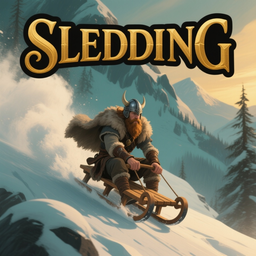
Sleds for Valheim: ride down snowy mountains or pull your sled on a rope. Five sleds, a racing bob among them. Build runs from a modular kit, any width, with walls, lanes, loops, boost pads, obstacles, timed races, portals and a scoreboard.
The run kit: runs are now built from floor plates (2 m by 4 m, side by side as wide as wanted, straight, rising, falling, curved, loop pieces, wedges for funnels and fans, straw), sides on their edges (banks, walls upright or leaning, stacked as high as wanted, lane dividers, a wooden lip curling in over the run so a sled riding up is turned back in) and gates and portals that span the whole row; start blocks of one to four lanes come ready. Every piece joins at any free edge and rides both ways; eight loop pieces make a loop. While building, J steps through the tab's pieces at the ghost and K extends a run by its whole cross-section, in the floor shape chosen. Plates press their bed into a slope, pads bend along bending plates, posts snap under plate corners. The ready-made pieces of 1.2 to 1.4 still load and ride (in the hammer with ClassicRunPiecesInHammer).
Fields and obstacles (pads, ramps, the hump, bales, poles, bumpers, moving wall, spinner) have a tab of their own, Run: fields.
Fixed: the picture shook all the time on a sled, even standing still (the camera turned back and forth by a degree or more every frame). It is still now.
Fixed: on a server a track's name, a race start, the laps or a finish time could be lost when nobody happened to be in charge of the gate at that moment (the server hands a piece back when its player moves on). Whoever asks now takes the piece over first.
Fixed: the moving wall and the spinning bar jerked (they followed the network clock, which moves on once a frame and is set anew by the server every few seconds); they now move smoothly with every physics step.
Fixed: a parked sled never came to rest: it dropped a hair and sprang back five times a second and crept along the ground, and a seated sled standing still did the same (with anti-aliasing on, its parts seemed to wobble against each other). Sleds standing still are now still, parked or with a rider who holds no key; the long bob no longer rocks corner to corner.
Fixed: while riding, the planks, posts and rails of a sled wobbled each on its own and changed their brightness (the wood came from building pieces, whose shader shifts every corner a little and shades it by where it stands in the world). Sleds, the moving wall, the spinning bar, slalom poles and the start barrier now use the wood the game gives its boats.
Fixed: sitting on a sled, the picture swayed slowly with the rider's breathing and thin shadows (the start barrier's) flickered; the camera now holds still on the sled.
Fixed: the start barrier looked almost white; it is red and white again.
Fixed: changing the snap point (Q/E) while holding a kit plate near a run made it flicker between two places.
Kit plates turn with the mouse wheel. Come to a free edge, the hammer turns along it by itself (a run goes on round its curves without turning by hand; at a run's start it turns back, and the plate joins it backwards); one step of the wheel from there sets the plate free, turned that step, to begin another heading right beside the run. The same for start blocks.
The lip's back is closed: its planks were offset face by face and gaped at every bend, and the run showed through from behind.
All sleds on a hammer tab of their own, Sleds (they were among the game's carts and boats); the run's tabs all named alike and in the order used: Run: floor, Run: curves, Run: sides, Run: race (was Racing), Run: fields (was Fields and obstacles).
Fixed: on the racing bob the crew's feet came out under the shell. The crew sits up a little higher and the shell is fuller at the sides.
Fixed: a lip on a wall that ends hung in the air where the wall ran out; the parts of a stack now come down together.
Fixed: on a server a sled coming out of a portal could vanish from under its riders for a moment (the game tidied it away before the riders' own position had followed it). A sled in or just out of a portal, or ridden, now always stays.
Building either way: a run piece joins any free end or start of a run, so a run can be built up from the bottom, a piece put in front, or a gap filled where one was taken out. Where two pieces already meet, nothing else snaps in.
Uphill pieces for jumps and humps: 10° to 40° up, steeper and steeper, and flattening out at the top. A sled leaving an uphill end flies.
Curves down 20° and 30° and up 10° and 20° (22.5° to 90°, left and right), and bobsleigh curves and hairpins down 20°.
Side wall: set onto any run piece (curve, straight or change of slope, any width), it raises the bank aimed at by 1.6 m, for curves taken very fast. Walls on pieces next to each other join into one long smooth wall, at full height through every joint; it runs out only where the row ends.
Outlet and inlet: from a run out onto a field of plates and from the field back into a run (single and wide, level and 10°); plates snap to their open ends.
Fast curves hold better: a sled thrown up off a bank or a crest is held to the lining (only kickers, ramps, jump pads and open ends throw it into the air), at the rim of a bank it slides along instead of over it, and a hard knock into a bank no longer throws it up. Tested: a tight 45° curve at about 80 km/h and a wide 90° sweep of four 22.5° curves at 110 km/h, with and without curve walls.
Wide runs, 12 m, open or in three lanes with walls between them: straights, changes of slope and curves; a fan and a funnel between a single and a wide run, a fork (one into three lanes) and a join (three into one), and lanes beginning and ending on a wide run. A single run joins each lane's end.
An open field: plates of run lining without banks, 4 m square, laid side by side; small and big ramps and a hump to set on a field or a run; straw bales (they stop a sled, never break it) and slalom poles (brushing one costs a little speed).
Pads to lay on a run: boost, strong boost, slow and hop, each for a moment after the sled rides over it.
Jump pads throw a sled straight up, about 6 m or (big) about 12 m, keeping its speed along the way: up onto a run or a field higher up. Landing pads (3.6 × 6 m) catch a sled coming down on them: no damage from the drop, the riders stay on and ride on.
Racing: start, checkpoint and finish gates belong to a track by its name (E, like a portal's tag). A run counts only at a finish of the same track, and only after every checkpoint of the track; checkpoints show the time so far and the difference to the record run. A finish keeps the ten best times. Start, checkpoint and finish gates over three lanes.
Scoreboard: shows the best time of every track in the world, or the ten best of one.
Races started together: Shift + E at a start gate lowers a barrier across the run, the riders line up behind it, a countdown runs and the barrier rises straight up at "Go!" (on every lane at once). Every sled's clock runs from that moment, and the finish announces each one's place in the race to everyone near. Until "Go!" the line cannot be crossed: a sled shoved over it anyway (or seen late through the network) is put back behind it, a false start.
Laps: a start gate is set to 1–20 laps (N). With more than one, the track is a circuit: each pass of its finish is a lap (lap number, time so far and lap time shown), every checkpoint must be passed each lap, the start does not restart the clock on the way round, and the run counts after the last lap.
Sled portals: ride through the way in and come out of the way out of the same name with riders, cargo and speed, anywhere in the world. A run's clock goes on, without the time between. Ore does not go through, as with the game's portals.
The racing bob, a fifth sled for two (forge, iron), after a real competition bob: a painted shell round the crew with a long covered nose, steel runners and push bars; ten colours (N while looking at it); the pilot leans into the run and the brakeman tucks in behind. On a run the fastest of all, its top speed almost a third higher; off a run heavy and slow.
More obstacles for fields and wide runs: a bumper post that throws a sled back, a moving wall sliding 8 m to and fro across the way, a spinning bar, and a slush field that brakes a sled all the way across. None of them breaks a sled.
Two sleds bumping into each other is no crash.
New hammer tabs Wide runs and Racing; the start and finish gates moved to Racing. New setting PortalPieceRecipe.
Players and server must update together (1.3 and 1.4 do not mix).
1.3.0
Down steep walls: straights of 50°, 60°, 70° and 80° and the changes of slope between them, in steps of ten. Past 40° a piece is measured along the run (a straight four metres, a change five) and its cross-section stands square on the steep floor, so its banks still stand out from it.
At the foot of a wall the changes of slope are rounder: a sled caught at 160 km/h is pressed in with about four times its weight and rides on.
Steep pieces press no bed into the slope (the game's digging would cut into the rock above them).
The runs of 1.2 keep their shape: nothing up to 40° has changed.
Fixed: at high speed a rider could be put off the sled (the check for a rider who has gone away allowed only for walking pace, not for the delay of a sled at 150 km/h or of a rider seen through the network).
Fixed: sleds could not be taken apart with the hammer (the game's cart they are made from cannot). Now they come down like anything built with it and give back their materials, though not while someone sits on them or pulls them; their cargo is left in a crate.
Fixed: when a sled broke or was taken apart, the crate with its cargo and its materials appeared inside the hull and were flung far away (the crate some thirty metres). They now stay where the sled stood.
Players and server must update together (1.2 and 1.3 do not mix).
1.2.0
Two new hammer tabs, Sled runs and Run curves, with 49 pieces for proper sled runs and bobsleigh tracks, also down a whole mountainside. Each is packed snow between curved banks in a plank frame with a log rail, 4 m wide.
Straights (level to 40°), pieces that turn steeper or flatter, entries from the slope (a wide mouth flush on the ground), side entries, curves of 22.5°, 45°, 67.5° and 90° left and right (level or 10° down), a kicker, an uphill run-out and a straw run-out.
Bobsleigh pieces: steep 90° curves and 180° hairpins with a 2.4 m outer wall, nearly upright. Two hairpins make a "Kreisel", quick curves to and fro a labyrinth, steep curve, hairpin and steep curve an omega.
A run is fast: its lining glides far better than open snow, its walls hold the sled at any speed and over a crest it keeps the sled on the lining. Up to about 160 km/h (RunMaxSpeed). Straw ploughs deep: two pieces stop a sled from about 90 km/h, three from about 150 km/h.
Building on a mountain: a run piece held on a slope points down the fall line; one held near the end of another joins it. A new piece presses its bed into the slope (up to 2 m, never heaped up; RunPressesIntoSlope). Held with the free-placement key, a piece goes exactly where it is put.
Start and finish gates time a run: the riders see their time and top speed, and the finish gate keeps the track record (who, on which sled). Its builder can clear it.
Riding into a run's banks, walls or rails is never a crash. Riding on a run counts as being on the ground; the sledding skill grows half again as fast there.
Sleds ride more steadily: their runners no longer spring back out of a hollow, they lie along the ground over a crest, and a sudden knock in a hollow no longer brakes them hard.
New settings under 4 - Sled runs (server-synced): RunPieceRecipe, RunPieceStation, RunMaxSpeed, RunPressesIntoSlope.
Players and server must update together (1.1 and 1.2 do not mix).
1.1.0
New skill: Sledding, in the skill list with its own icon. You learn it by riding (by the speed), by landing jumps, a little riding behind or pulling. It drops on death like every skill.
At level 100 the runners grip 25 % better in turns, you steer 15 % quicker, drag is 8 % lower, the safe drop rises from 6 to 9 m and the break height from 15 to 20 m, and the sled takes 30 % less damage. The one in front counts, or the one on the rope.
New settings under 3 - Skill (server-synced): SkillBonuses and SkillGainRate.
Sleds ride up onto built edges up to 60 cm high (a roof piece laid as a kicker, a floor, a doorstep) instead of crashing into them, so roof pieces and stairs make chutes and jumps. Walls, trees and higher edges are still a crash.
Players and server must update together (1.0 and 1.1 do not mix).
1.0.0
First release: four sleds in the hammer's Misc tab. The wooden sled (workbench), the bronze-shod sled (forge), the mountain sled with silver shoes and a wolf pelt (forge) and the great sled for two with carved bow posts (artisan table).
Riding: E to sit down. A/D steer, W kicks off, S brakes, Shift ducks, Space or E jumps off. The sled glides on snow and ice and needs a real hill on grass and earth. It drifts wide in hard turns at speed instead of spinning round. Hiss and scrape sounds and snow spray, for everyone nearby.
Pulling: Shift + E takes the tow rope; a friend may sit on the sled meanwhile. E on the sled you pull lets go and sits you down.
Falls are judged by the speed straight into the ground. Sliding down a steep mountainside is never a fall. A drop of 6 m onto flat ground is harmless, from 15 m the sled breaks. Riders are hurt then, or when they crash into a tree or rock at speed, but a sled never kills.
A broken sled leaves half its materials and its cargo. An empty sled holds on any slope a player can stand on, and turns itself upright when it lies on its side.
Small cargo on the small sleds (2 to 4 slots), a real load on the great sled (8 slots), shown as bundles on the deck.
Recipes, stations, cargo sizes, top speed and the fall heights can be configured (server-synced). Texts in English and German.
Thunderstore development is made possible with ads. Please consider making an exception to your adblock.