
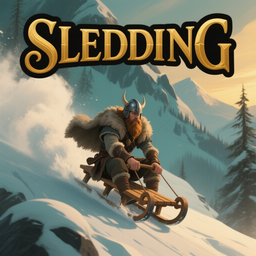
Sledding
Sleds for Valheim: ride down snowy mountains or pull your sled on a rope. Four sleds from workbench to artisan table, the great one for two. Build banked sled runs with curves and kickers. A sledding skill helps you steer and land.Sledding – down the mountain, or behind you on a rope
Valheim has whole mountains of snow and no way to slide down them. This mod adds sleds: sit on one and ride down a slope, or pull it along behind you on its rope. There are four of them, from a little wooden sled at the workbench to a great sled for two from the artisan table.
Sleds are mostly for fun. The small ones carry a bundle or two, about what fits on a child's sled. Only the great sled carries a real load.
| Sled | Built at | Cost | Seats | Cargo | Top speed on 30° of snow |
|---|---|---|---|---|---|
| Wooden sled | Workbench | 10 Wood, 4 Leather scraps | 1 | 2 slots | ~86 km/h |
| Bronze-shod sled | Forge | 10 Fine wood, 2 Bronze, 2 Deer hide | 1 | 3 slots | ~91 km/h |
| Mountain sled | Forge | 12 Fine wood, 4 Silver, 3 Wolf pelt, 4 Leather scraps | 1 | 4 slots | ~98 km/h |
| Great sled | Artisan table | 20 Fine wood, 6 Black metal, 4 Lox pelt, 8 Linen thread | 2 | 8 slots | ~93 km/h |
All of them are in the hammer's Misc tab. The later sleds glide better, steer more surely, turn more sharply and take more knocks. The mountain sled, with silver shoes on long runners, is the fastest and nimblest of all.
Riding
Look at a sled and press E to sit down. Then:
| Key | |
|---|---|
| A / D | steer |
| W | kick off with your feet (costs stamina; only helps when slow) |
| S | brake: dig in your heels |
| Shift | duck down: less air resistance, a little faster |
| Space or E | jump off |
Gravity does the rest. On snow and ice a sled runs away with you on even a gentle slope. On grass, earth or moss it needs a real hill. For a proper run, build one from the hammer's Sled runs tab (see Sled runs); vanilla roofs and floors can be ridden too (see Building runs and jumps).
Turning is best at a brisk pace. At speed the runners skid when you steer hard: the sled drifts wide instead of spinning round. The sled hisses on snow, scrapes on earth and throws up snow behind it, and anyone nearby hears and sees it.
On the great sled the one in front steers and the one behind just enjoys the ride.
An empty sled left on a slope stays where it is, on any slope you could stand on yourself. A sled lying on its side or back turns itself upright again after a moment.
Pulling
Shift + E takes the tow rope, and the sled follows you through the snow. Pulling it on snow is easy; dragging it uphill or over grass is harder.
You can pull a friend sitting on the sled. Press Shift + E again to let go. Or press E on the sled you are pulling: you let go of the rope and sit down. Pull it up the hill, then ride it down.
The rope slips from your hand if the sled gets stuck far behind you, or when you sit down, travel through a portal or die.
Falls, crashes and steep slopes
A sled is judged the way your legs are: by the speed straight into the ground, not by how far it fell.
- Sliding down a steep mountainside is never a fall. However steep and however fast, as long as the sled runs along the ground, nothing happens. That holds even where you would slip and tumble on foot.
- A real drop onto flat ground is judged by its height. Up to 6 m nothing happens. Between 6 and 15 m the sled takes damage. From 15 m on it breaks apart: the riders are thrown off and hurt, but a sled never kills. Everyone keeps at least 1 health, and a feather cape protects you as usual.
- A jump that lands on a downslope is gentle, just as on skis. The same jump onto flat ground is not.
- Hitting a tree, a rock or a wall at speed damages the sled, and from about 40 km/h on it throws you off.
A broken sled leaves half of its materials behind, and whatever cargo it carried. Taken apart with the hammer, it returns all of them. A damaged sled is repaired with the hammer like any building piece.
The sledding skill
Sledding is a skill of its own, in your skill list next to the game's skills. Like those, you learn it by doing it:
- Riding teaches by the speed: about one point a second at 40 km/h, up to 2.5 from 72 km/h on. Kicking off on flat ground teaches nothing, and only what the runners cover counts: not a fall, not a ride on a ship's deck.
- A jump you land without harm (at least 0.7 s in the air) is worth 2 points.
- Riding behind on the great sled, or on a sled someone pulls, teaches a quarter as much: you do not steer.
- Pulling a sled on its rope teaches a little: 1 point for every 25 m.
The first levels come within a few runs. Level 50 takes about an hour of fast riding, level 100 about five and a half, about as long as the game's own riding skill. Like every skill, it drops a little when you die.
What it does, growing evenly up to level 100:
| Level 0 | Level 100 | |
|---|---|---|
| Grip of the runners in a turn | as the sled is built | +25 %: the tail breaks away later |
| Steering | as the sled is built | +15 % turn rate |
| Air and snow drag | as the sled is built | −8 %: top speed about 4 % higher |
| Safe drop onto flat ground | 6 m | 9 m |
| Drop that breaks the sled | 15 m | 20 m |
| Damage to the sled from hard landings and crashes | full | −30 % |
Only the skill of the one in charge counts: the one in front, or the one on the rope when nobody sits in front. A sled still never kills, whatever the skill, and the fall heights scale with the server's SafeDropHeight and BreakDropHeight.
Sled runs
Two tabs of the hammer, Sled runs and Run curves, hold 61 pieces for a proper run, from a little toboggan run to a bobsleigh track down a whole mountainside and down walls as steep as 80°. Each is a trough of packed snow between two curved banks, in a plank frame with a log rail on top: 4 m wide, 6 wood and 2 resin at the workbench.
A run is fast. Its groomed lining glides far better than open snow, and its walls hold the sled: the steeper and longer the run, the faster it goes, up to about 160 km/h (RunMaxSpeed). On open snow a sled tops out near 100 km/h.
| Piece | |
|---|---|
| Straight | level, 10°, 20°, 30°, 40°, 50°, 60°, 70°, 80°, 4 m long (the steep ones measured along the run) |
| Steeper | 0° → 10° and so on in steps of ten up to 70° → 80°: the slope changes without a jolt |
| Flatter | 80° → 70° and so on down to 10° → 0°: the run catches the sled in the hollow |
| Entry from the slope | 10°, 20°, 30°, 40°: a wide mouth lying flush on the ground, narrowing into the run |
| Side entry | left or right, 20°, 30°, 40°: one bank gives way to a low apron, the far wall stands higher |
| Curve | 22.5° (a wide sweep for a fast line), 45°, 67.5° and 90°, left or right, level or 10° down, with a raised outer bank |
| Steep curve | 90°, left or right, 10° down: a bobsleigh curve whose outer wall rises 2.4 m, nearly upright |
| Hairpin | 180°, left or right, 10° down, with the same high wall |
| Kicker | curves up to 28°, a metre above the run |
| Start gate | a level piece under a gate: the clock starts when a sled passes under it |
| Finish gate | a level piece under a chequered gate: it stops the clock and keeps the track record |
| Uphill run-out | 0° → 15° uphill, and 15° uphill: as on a real track, the climb takes the speed out |
| Straw run-out | the runners plough deep: two pieces stop a sled from about 90 km/h, three from about 150 km/h |
Curves come in steps of 22.5° because that is how far the hammer turns a piece. A 75° curve would leave the next piece askew; take 67.5° or 90°.
Down a steep wall: past 40° the pieces go on to 80°. They are measured along the run (a straight four metres of it, a change of slope five), and their cross-section stands square on the steep floor, so the banks still stand out from it. At the foot of a wall the changes of slope are rounder: a sled caught at 160 km/h is pressed in with about four times its weight and rides on. Down 80° a sled reaches the run's top speed after some fifty metres. Steeper than 80° there is nothing to ride: at 90° it would be falling, and past it the floor would face the ground. Steep pieces do not press a bed into the wall (the game's digging would cut into the rock above them); lay them on the wall or just off it.
Down a mountain:
- Lay an entry on the slope. Held on a slope, a run piece turns by itself to point straight down the fall line (the hammer alone only turns in steps of 22.5°).
- Go on piece by piece. A piece held near the end of the last one joins it by itself, turned as that end points: aim at the end and place it. Pick the slope that follows the mountain: straight on, steeper or flatter.
- The run presses its bed into the slope. Where a piece lies a little in the mountain (up to 2 m), it lowers the ground under its trough, so no hump of the slope pokes into the run. It never heaps the ground up. Off with
RunPressesIntoSlope. - Ride in from the slope through the entry's mouth, or from the side over a side entry: put the side entry where the run lies level with the slope beside it.
- The walls hold the sled at any speed, and over a crest the run keeps it on the lining. Only a kicker throws it into the air.
- End in straw where the mountain flattens out, after an uphill run-out if you like: two straw pieces stop a sled from about 90 km/h, three from about 150 km/h.
- Placing freely: hold the key for placing without snapping (Shift) and a run piece goes exactly where you put it, turned as the hammer turns it, into the mountain if you like, like a floor or a stair.
Building a run elsewhere:
- Aim at the end of the last piece, and the next one joins it. Change the slope with a steeper or flatter piece; the 10° curves fit a 10° straight.
- A run piece holds like a wooden floor. Where it does not lie on the ground, put wooden poles under it.
- The banks are for riding. Running into a bank, a wall or a rail is never a crash. In a banked curve the sled leans in and comes round almost by itself; in a steep curve a fast sled rides high up the wall.
- A jump: after a kicker, leave a gap of about 3 m and start a 30° straight half a metre below the lip. The sled flies and lands softly on the slope; the faster it comes, the farther it flies, so give the landing slope room (at 60 km/h some 20 m).
Timing: put a start gate at the top and a finish gate at the bottom. Riding under the start gate starts the clock ("The clock is running!"). Under the finish gate the riders see their time and top speed, and a new track record is announced. The finish gate shows the record, who set it and on which sled; the one who built it can clear it (Shift + E).
The famous curves, built from the pieces:
- The "Kreisel" (a full circle): two hairpins the same way, one after the other. The run turns round once and passes under its own entry about 6 m lower.
- The labyrinth: quick curves to and fro, for example 45° right, 67.5° left, 67.5° right, 45° left.
- The omega: a steep 90° curve one way, then a hairpin and a steep 90° curve the other way: three quarters of a turn round a bend shaped like Ω.
Riding on a run counts as riding on the ground, and the sledding skill grows half again as fast there.
Tested in game: a run of 80° (twenty metres straight down a wall, caught below, 150–170 km/h); a 192 m run built down a real mountainside beside a 76° wall, following it at up to 60° (156 km/h, down to the straw); a run built down a real 35–40° mountainside as described above (entry, then pieces chosen to follow the slope, a side entry, straw at the foot), ridden in from the slope through the mouth and from the side over the side entry, each time from about 40 km/h on the slope to about 90–100 km/h on the run and to a stop in the straw; a 77 m run with banked curves, an 84 m run with a kicker and a jump, and a 170 m bobsleigh track with gates, labyrinth, Kreisel and omega. Every piece joins exactly onto the end of a straight, a curve and a hairpin.
Building runs and jumps
Sleds ride on built pieces as well as on snow. Wooden boards glide a little worse than snow, so a wooden run is quick but not icy.
- Chutes: A line of roof pieces (26° or 45°) or wooden stairs makes a slide. The sled runs from piece to piece without a bump and out onto the ground below.
- Kickers: A roof piece laid on the ground as a ramp makes a jump. Like curled runners, the sled rides up onto any built edge up to 60 cm high: the eave of a roof, a floor, a doorstep. A higher edge, a wall or a tree is still a crash.
- One 26° roof piece (1 m high) at about 50 km/h throws the sled 6 to 10 m. A steep 45° kicker sends it high and spinning. Landings are judged as always: gently on a downslope, by the drop on flat ground.
The real thing
Sleds are far older than wheels in the north. Runners of sledges from around 7000 BC have been found in Finland and Russia. The Oseberg ship burial in Norway (834 AD) held four richly carved sledges, with posts ending in animal heads. They are the model for the great sled here. People pulled sleds over snow and ice in winter, when the roads were frozen and the bogs could be crossed.
The physics here is simple:
- Snow is slippery. A waxed wooden runner on snow has a friction coefficient around 0.05; metal shoes and good snow bring it lower. On grass it is about five times as much.
- Air drag grows with the square of the speed, so every slope has a top speed where gravity and drag balance. Valheim's gravity is 20 m/s², about twice Earth's, so everything is a bit livelier than at home.
- A rider sits low and leans into the turns. The runners cut into the snow and hold the line until the sideways force is too great, and then they skid.
| Slope (snow) | 10° | 20° | 30° |
|---|---|---|---|
| Wooden sled | 45 km/h | 69 km/h | 86 km/h |
| Mountain sled | 54 km/h | 80 km/h | 98 km/h |
These are top speeds on an endless slope. A real run is shorter, so a sled seldom gets that fast.
Configuration
BepInEx/config/zap.sledding.cfg. The settings under 1 - Sleds are the server's: on a server they apply to everyone, and only admins can change them in game.
<Sled>Recipe,<Sled>Station,<Sled>Cargo: build cost, crafting station and cargo size (e.g.4x2) of each sledMaxSpeed(28 m/s ≈ 100 km/h)SafeDropHeight(6 m),BreakDropHeight(15 m)RiderCanBeHurt,CrashThrowsRiderPushStamina: stamina per second for kicking off
Under 4 - Sled runs, also the server's: RunPieceRecipe (Wood:6,Resin:2) and RunPieceStation (piece_workbench) for every run piece, RunMaxSpeed (45 m/s ≈ 160 km/h on a run) and RunPressesIntoSlope (on).
Under 3 - Skill, also the server's:
SkillBonuses(on): the sledding skill helps its rider. Off, it still grows but does nothing.SkillGainRate(1): how fast it grows; 0 stops it. The world's own skill gain setting applies on top.
Under 2 - Client each player sets their own ShowControls (key help when sitting down), ShowRunStats (after a long run: its length, top speed and drop) and Volume of the runners.
Multiplayer and compatibility
- Every player and the server need the mod (same minor version).
- Whoever sits in front, or holds the rope, simulates the sled on their own machine, so it handles without lag. Everyone else sees it ride smoothly with its riders on board. When someone pulls a sled with a rider in front, the rider's skill is sent to the puller's machine.
- While someone rides or pulls a sled, nobody else can open its cargo or take it apart.
- The sleds are new pieces with their own names: nothing of the game's cart is changed.
Deutsch
Schlitten für Valheim. Setz dich drauf und fahr verschneite Berge hinab, oder zieh ihn am Seil hinter dir her. Es gibt vier Stück:
- Holzschlitten (Werkbank, 10 Holz, 4 Lederfetzen): 1 Platz, 2 Ladefelder
- Bronzebeschlagener Schlitten (Schmiede, 10 Feinholz, 2 Bronze, 2 Hirschhaut): 1 Platz, 3 Ladefelder
- Bergschlitten (Schmiede, 12 Feinholz, 4 Silber, 3 Wolfsfell, 4 Lederfetzen): der schnellste und wendigste, 4 Ladefelder
- Großschlitten (Kunsthandwerkstisch, 20 Feinholz, 6 Schwarzmetall, 4 Loxfell, 8 Leinengarn): 2 Plätze, 8 Ladefelder
Alle findest du im Hammer unter Sonstiges.
Fahren: E zum Aufsitzen. A/D lenkt, W stößt ab (kostet Ausdauer), S bremst, Umschalt duckt (weniger Luftwiderstand), Leertaste oder E springt ab. Auf Schnee und Eis geht es schon am sanften Hang los. Auf Gras und Erde braucht es einen richtigen Hügel. Auf dem Großschlitten lenkt, wer vorne sitzt.
Ziehen: Umschalt + E nimmt das Zugseil, noch einmal lässt es los. Ein Freund darf dabei sitzen bleiben. E auf den gezogenen Schlitten: Seil loslassen und aufsitzen. So ziehst du ihn bergauf und fährst bergab.
Stürze: Es zählt nur die Geschwindigkeit senkrecht in den Boden. Einen steilen Berghang hinabzurutschen ist nie ein Sturz, so schnell es auch geht. Ein echter freier Fall auf flachen Boden ist bis 6 m harmlos. Bis 15 m wird der Schlitten beschädigt, darüber bricht er. Dann fliegen die Fahrer herunter und werden verletzt, aber ein Schlitten tötet nie: Mindestens 1 Leben bleibt. Wer mit Tempo gegen Baum, Fels oder Mauer fährt, beschädigt den Schlitten und fliegt ab etwa 40 km/h herunter. Ein zerbrochener Schlitten hinterlässt die Hälfte seiner Materialien und seine Ladung.
Fertigkeit Schlittenfahren: Sie steht in deiner Fertigkeitenliste und wächst wie die des Spiels durch Tun: beim Fahren nach dem Tempo (bei 40 km/h etwa ein Punkt pro Sekunde; Abstoßen in der Ebene, Fallen oder Mitfahren auf dem Schiff zählt nicht), mit 2 Punkten für einen sauber gelandeten Sprung, ein Viertel davon hinten auf dem Großschlitten und ein wenig beim Ziehen. Stufe 50 braucht etwa eine Stunde schnelle Fahrt, Stufe 100 etwa fünfeinhalb. Auf Stufe 100 halten die Kufen in der Kurve 25 % besser, du lenkst 15 % schneller, der Luftwiderstand sinkt um 8 % (etwa 4 % mehr Spitze), du landest sicher aus 9 m statt 6 m, der Schlitten bricht erst ab 20 m statt 15 m und nimmt 30 % weniger Schaden. Es zählt, wer vorne lenkt, sonst wer zieht. Beim Tod sinkt sie wie jede Fertigkeit; ein Schlitten tötet trotzdem nie. Ein- und ausschalten und das Lerntempo einstellen kannst du unter 3 - Skill.
Schlittenbahn und Bobbahn: Im Hammer gibt es zwei eigene Registerkarten, Schlittenbahn und Bahnkurven, mit 61 Stücken: eine 4 m breite Rinne aus festem Schnee zwischen gerundeten Banden, in einem Bretterrahmen mit Handlauf, je 6 Holz und 2 Harz an der Werkbank. Es gibt Geraden (eben bis 80° in 10°-Schritten), Übergänge steiler und flacher werdend, Einfahrten vom Hang (10° bis 40°, ein breites Maul bündig auf dem Boden), Seiteneinfahrten links und rechts, Kurven mit 22,5°, 45°, 67,5° und 90° (eben oder 10° Gefälle), Steilwandkurven (90°) und Haarnadeln (180°) wie im Eiskanal, eine Schanze, Start- und Zieltor mit Zeitmessung, einen Auslauf bergauf und einen Auslauf mit Stroh. Die Bahn ist schnell: Ihr Belag gleitet viel besser als freier Schnee, ihre Wände halten den Schlitten bei jedem Tempo, und über Kuppen bleibt er am Belag; je steiler und länger die Bahn, desto schneller, bis etwa 160 km/h (RunMaxSpeed). Steilwand: Über 40° geht es bis 80° weiter. Die steilen Stücke werden entlang der Bahn gemessen (eine Gerade 4 m, ein Übergang 5 m), ihr Querschnitt steht senkrecht auf dem steilen Boden, und unten fangen rundere Übergänge den Schlitten auch mit 160 km/h auf. Steiler als 80° gibt es nichts zu fahren: Bei 90° wäre es ein Fall, darüber zeigte der Boden nach unten. Steile Stücke drücken kein Bett in den Hang (das Graben schnitte den Fels darüber an). Am Berg: Eine Einfahrt auf den Hang setzen, sie zeigt von selbst die Falllinie hinab. Jedes weitere Stück setzt sich am Ende des vorigen an, richtig gedreht. Wo ein Stück bis 2 m im Hang liegt, drückt es sein Bett in den Hang, damit kein Buckel in die Rinne ragt (aufgeschüttet wird nie; abschaltbar mit RunPressesIntoSlope). Vom Hang fährst du durch das Maul der Einfahrt hinein oder von der Seite über eine Seiteneinfahrt; die gehört an eine Stelle, wo die Bahn bündig im Hang liegt. Mit gehaltener Umschalt-Taste setzt du ein Stück ganz frei wie eine Fußplatte oder Treppe, auch in den Berg hinein. Kurven gibt es in 22,5°-Schritten, weil der Hammer so weit dreht; eine 75°-Kurve würde das nächste Stück schief ansetzen. Ein Bahnstück hält wie ein Holzboden: Wo es frei hängt, gehören Holzpfosten darunter. In Banden und Wände zu fahren ist nie ein Crash. Unter dem Starttor läuft die Uhr, unter dem Zieltor sehen die Fahrer Zeit und Spitze, und das Zieltor merkt sich den Bahnrekord (sein Erbauer löscht ihn mit Umschalt + E). Berühmte Kurven baust du aus den Stücken: den Kreisel aus zwei gleichen Haarnadeln, das Labyrinth aus schnellen Wechselkurven, das Omega aus Steilwandkurve, Haarnadel und Steilwandkurve in Gegenrichtung. Jede Bahn endet im Stroh: zwei Stück halten einen Schlitten aus etwa 90 km/h an, drei aus etwa 150 km/h. Auf der Bahn zählt das Fahren als Bodenkontakt, und die Fertigkeit wächst anderthalbmal so schnell.
Bahnen und Schanzen: Gebaute Teile kann man befahren. Eine Reihe Dachteile (26° oder 45°) oder Holztreppen ergibt eine Rutschbahn: Der Schlitten gleitet ohne Ruckeln von Teil zu Teil und auf den Boden hinaus. Ein als Rampe auf den Boden gelegtes Dachteil ergibt eine Schanze. Kanten bis 60 cm Höhe (Traufe, Boden, Türschwelle) fährt der Schlitten hinauf wie mit gebogenen Kufen. Höhere Kanten, Mauern und Bäume bleiben ein Crash. Holz gleitet etwas schlechter als Schnee.
Alle Werte stellst du in BepInEx/config/zap.sledding.cfg ein. Auf einem Server gelten die des Servers.